Must-Use Facebook Ads Strategies for Ecommerce

As someone actively promoting an online store, I bet you’ll agree:

Whatever marketing channels you use, it’s never enough.

You constantly need:

  • More conversions to meet sales targets.
  • Highly relevant traffic instead of accidental visitors.
  • And a way to increase repeat sales from past customers.

And yet you’re unsure about trying Facebook Ads.

Why?

With 1.39 billion monthly active users, the largest number of ecommerce orders from social media and a typical ROI from Facebook ads at 152%, not advertising on the platform is a missed opportunity.

If you’re unsure how to get started with Facebook Advertising though, read on.

Here are some of the strategies I use to help online retailers increase traffic and conversions.

1. Use Dynamic Product Ads

Dynamic product ads might be the highest ROI strategy eCommerce sites can use – a chance to bring back hesitant customers by showing them tailored ads based on their activity on your site.

You’ve probably seen large sites like Amazon.com retarget you on Facebook with offers for the exact products that you recently visited.

But did you know that you could remarket on Facebook just like Amazon?

With Dynamic Product Ads‘ templates, you don’t have to create ads for each product in your catalog. Instead, templates will pull images, product names, pricing and other information from your product catalog, based on the product details you upload to Facebook. So if you have hundreds or thousands of products, this could be a great solution for you.

With dynamic ads you can display single or multi product ads to customers who have visited your site based on products they viewed, added to the cart or even purchased.

To get started with Dynamic Product Ads:

  • Upload your product catalog to Facebook Business Manager. Include all products you want to promote with information to display for each product (name, price, image,).
  • Add a custom audience pixel to your siteModify it to report on customers’ buying behavior.
  • Create a dynamic template. Facebook will automatically populate it with the right products and associated info. Give your ads a title, specify keywords to pull in images, product names from the product catalog.
  • Set up Display Product Ads in the Power Editor. Specify if you want to advertise products from your entire catalog or just certain categories and …. run your ads.


2. Use Multi-Product Ads

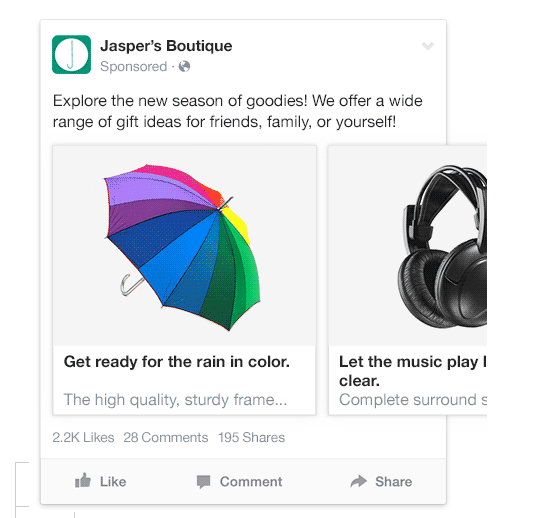
Facebook Multi-product ads give you the ability to show multiple products in a single ad.

Facebook-Multi-Product-Ad

  • Multi-Product Ads can give your customers more options to choose from.
  • They can help you increase conversions. The more relevant products a customer sees the greater the chance of them buying.
  • You can also use them to show different benefits of a single product.

But do they work?

Adobe discovered that their customers experienced:

  • A 50% to 300% increase in click-through-rate (CTR).
  • Up to 35% reduction in cost per click as a result of higher engagement.
  • More efficient cost per acquisition.

Multi-product ads can easily be set up in the Power Editor and can also be used as part of a dynamic product ad campaign or as a stand alone ad.

3. Install Conversion Tracking Pixel

A conversion-tracking pixel is a small snippet of code that tracks your customers’ behavior on the site. But it does so much more than that.

In addition to tracking customer behavior and conversions, Facebook can use the data from conversion pixels to optimize your campaigns and to build a lookalike audience to target your ads.

By placing a conversion-tracking pixel on your checkout page, you’ll be able to track actions (like sales, etc) people take after clicking on your ad and measure your ROI.

But to achieve the best results, I recommend installing the pixel long before you run your first campaign.

This way you’ll give Facebook time to learn the types of people who are converting into customers on your site even when they come from other marketing channels. If Facebook hasn’t tracked any conversion on your site yet, they’re going to have trouble optimizing your campaign for conversions.

4. Run General Retargeting Campaigns

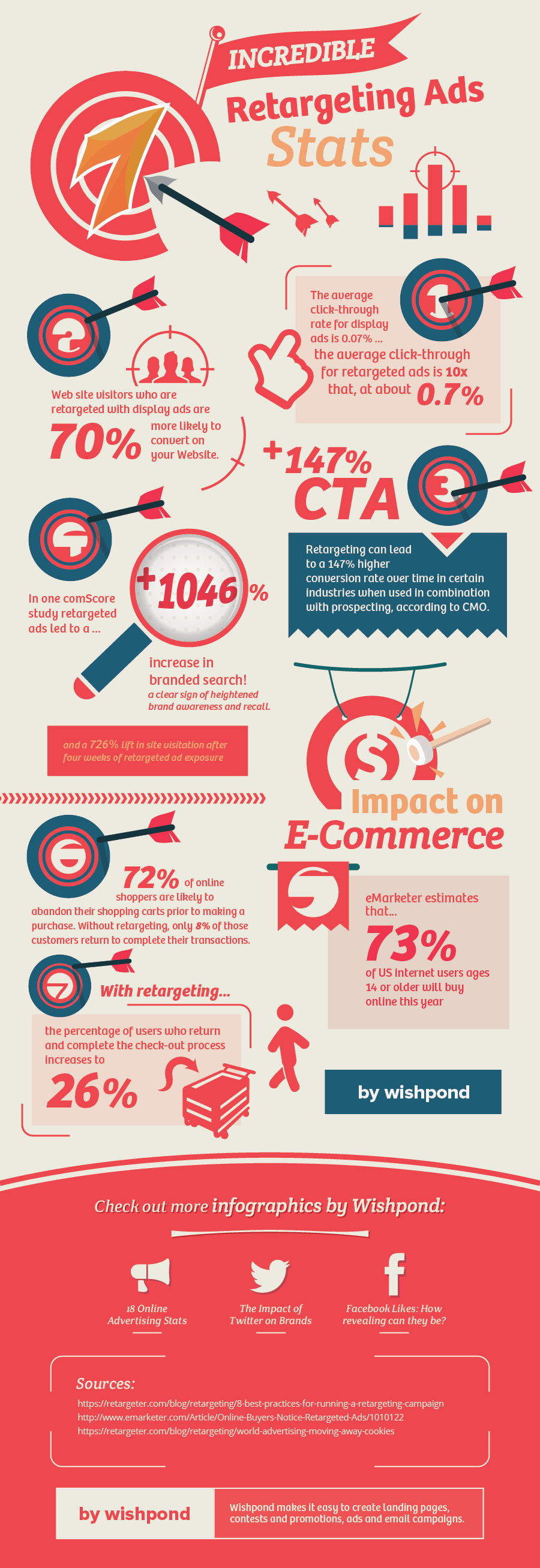
72% of online shoppers on average abandon their carts without completing a purchase.

Without retargeting, only 8% of them will come back to buy.

With retargeting however the average site can bring back 26% of abandoners to complete a purchase

According to Wishpond, the source of the data above, 70% of web visitors who are retargeted with display ads are more likely to convert on your site.

And the average CTR of retargeted ads is 10x higher than standard display ads.

It goes without saying then – not retargeting your visitors costs you conversions and sales.

You can run retargeting campaigns via the Power Editor and target your visitors with general offers, coupons, single and multi-product ads and more.

5. Find New Customers with Lookalike Audiences

Facebook-LookalikeFacebook can help you to find new customers based on your past customers characteristics.

Lookalike Audiences help you advertise to people who are similar to your existing customers and likely to be interested in your products as well.

I’ve found that Lookalike audiences are usually one of the highest performing target groups for most of my clients.

To create a Lookalike Audience you need a Custom Audience to base it on. Alternatively, you could also build it from your Facebook Fans or data from the conversion-tracking pixel.

Lookalike Audiences will utilize Facebook’s algorithms to to find people with similar demographic characteristics and interests to your customers.

Of course you can also use Facebook’s other interest and demographic targeting options to find relevant new customers.

Benefits of Customer Segmentation for Higher Profitability

Research conducted by Econsultancy in association with IBM Watson Marketing surveyed over 1,000 professionals in marketing, eCommerce, and digital. They found that customer segmentation was the topmost priority among these professionals. 72% of them said that they use customer data for segmentation. In fact, even the most laggard businesses consider segmentation as a standard strategy.

This really shouldn’t come as a surprise. Every buyer has individual preferences, needs, and behavioral patterns. And 59% of people who have had a personal experience with brands think that personalization has a significant influence on purchases. However, it’s impossible to cater to each and every person based on their individual traits. And that’s why you need customer segmentation. In this post, we will discuss four benefits of customer segmentation for higher profitability.

1. Personalization

HubSpot analyzed over 330,000 calls-to-action and their performance over a 12-month period. They found that personalized calls-to-action performed 202% better compared to generic calls-to-action. Providing a great customer experience is the need of the hour for every business today. In fact, 80% of people perceive customer experience to be as important as a brand’s services or products. And personalization can go a long way to ensure that you provide exceptional customer experience.

Rocksbox is a jewelry discovery and shopping service, provider. Customers can rent unlimited fashion jewelry from top brands and designers by paying a monthly fee. As part of their growth strategy, they require each of their customers to participate in a survey. This survey helps Rocksbox get a better sense of the personal style preferences of their subscribers.

Image via Rocksbox

Using such data, they create various customer segments so that they can send their customers jewelry choices that are customized. Such segmentation helps to group your customers so that the communication with each group is suited to their taste.

Bottom line: Segmentation can help you provide your customers with more personalized communication and experiences, which can lead to higher profitability.

2. Effective Acquisition and Retention

Customer segmentation allows you to learn a great deal about your customers so you can cater to their needs more efficiently. You can also tailor your communication depending on the customer’s lifecycle. 44% of marketers in a CMO survey said that they use customer segmentation to decide their acquisition strategy. And 38% of them said that they use it to decide their retention strategy.

For example, when you’re trying to convert a prospect, your communication needs to be more informative. At this stage, they would prefer to learn about the solutions to their problems. In later stages, you may need to talk about other related products in your communication.

Denamico created hyper-personalized newsletters by using the Smart Content feature from HubSpot. They customized the opening and the CTA of their newsletter emails according to a customer’s life cycle stage. This increased their open rates by 43%, while their CTR increased by 89%.

Image via Denamico

Customer segmentation also helps to create an effective retention strategy. You may need to apply a recovery strategy for some of your older and more valuable customers who have not made any purchases recently. You may also need to terminate potentially less valuable customers so that you can focus more on valuable ones.

LiftPoint Consulting took the time to identify their top 5% of customers who drove the highest revenue for them. They also identified a segment of high potential customers and optimized their marketing strategy to focus on these two segments. In addition to better customer retention and revenue stability, they managed to increase their customer value by 28%. There was a 40% increase in revenue during their key selling period.

Image via LiftPoint Consulting

3. Better ROI from Marketing

Braze (previously Appboy) analyzed their marketing data from over 30,000 campaigns they ran over two years. They found that campaigns that had been sent to well-thought-out customer segments saw 200% greater conversions than those sent to broad audiences.

Better Targeting

Successful marketing not only requires knowledge about who your customers are but also where exactly they are in the buying process. And customer segmentation based on such information can ensure that your marketing campaigns are truly effective. Zillow offers a comprehensive range of residential real estate services that include renting, selling, buying, remodeling, and even financing. They have a database of over 110 million homes for rent and sale.

Zillow uses customer segmentation to ensure that the right marketing messages are sent to the right people based on their life cycle stage. For example, to consumers who are looking to buy a home, they send emails about homes in their preferred locations. They also send notifications about price changes to homes they’ve saved. Using this strategy, they were able to achieve a 161% lift in their open rate and an 18% lift in their click-to-open rate.

Effective Channels and Content Formats

Customer segmentation can help you decide on the right kind of promotional content to send to your customers. For example, not all of them may like to receive notifications about discounts or offers but some of them might. B2C buyers are 1.3X more likely to favor newsletters or emails while B2B buyers are 22.X more likely to find them important. When it comes to retargeting, B2C buyers are 1.1X more likely to favor them while B2B buyers are 1.8X more likely to do so.

If you are aware of the preferences of your customer segments, you can send them information that they’ll appreciate. In fact, 76% of consumers expect that businesses are aware of their needs and preferences.

Segmentation also helps you select the right marketing channels for the right audience set. For example, if you’re planning to start a retargeting campaign on Facebook, which customer segments should you target?

Image via Facebook

The bottom line is that customer segmentation can help you ensure that you send the right marketing messages to the right people. It can help you leverage the most effective channels and content formats so that your chances of conversions are greater.

4. Unearth New Opportunities

With customer segmentation, you will never miss out on what’s trending. And you can even come up with new products or variations according to the changing preferences of your customers. If you are vigilant enough, you may also have the first mover’s advantage in a product segment.

EMM Group helped a bank identify a new and profitable segment, known as the “confident entrepreneur” segment. They helped develop a card offering and a new service package. They considered the segment’s emotional and functional needs to craft a new value proposition to resonate with them. Six months after they launched the new card, their portfolio share in premium cards increased from 8% to 51%. Their actives rate also saw a 7% incremental increase.

Final Thoughts

The standards of good customer experience are ever-increasing. In fact, 67% of customers don’t mind paying a premium if businesses can provide them with an amazing experience. Segmentation helps to grow your business by building long-term relationships with your customers and providing exceptional customer experiences. And above all, it helps you stay innovative or at least helps you to stay at par with your customer needs.

Having discussed all of the benefits, it’s important to emphasize that good data and analytics are the basis of segmentation. Data should be clean, updated regularly, and error-free. If the data is not correct or misinterpreted, then all segmentation efforts will be meaningless.

5 Ways To Boost eCommerce Rates (2020)

A lot goes into launching and building an eCommerce business.

First, you have to decide what you’re going to sell.

After you determine how you’re going to source your products, set up your store, and start sending visitors to your site with paid advertising, you may think that’s it – I’m off to the races.

Not so fast.

In an increasingly competitive digital buying world, there are some do’s and don’ts when it comes to encouraging customers to buy items from your business.

Ways to Boost Your Ecommerce Conversion Rates:

1. Use high-quality images and videos on your product pages.

Think about what you want to see when you are shopping.

When you are shopping online you can’t touch the product or put it on.

The best thing you can do is show a detailed image or video so that the customer knows exactly what they are getting.

I suggest using high-quality images and video on the product pages as that help the user visualize the product better and increases conversion rates.

2. Offer free shipping.

Online shoppers have come to expect a certain standard that they have grown accustomed to on Amazon.

If your store does not offer free shipping, customers are going to look elsewhere, period.

In today’s market, free shipping is an absolute must!

Think you can’t offer free shipping? Keep in mind that this is often a psychological game.

Increase your product prices to cover shipping costs if that’s what needs to be done.

3. Provide limited time coupon codes.

When your coupon code expires this will drive urgency and shoppers will more likely go through with the purchase and not get distracted.

4. Be competitively priced.

If you are selling brand name items that a lot of other stores offer, unfortunately, you need to price your products at or below the average price in order to compete.

Be sure to adjust your prices frequently to see what resonates.

Fitness brands like Lululemon and Outdoor Voices have done this extremely well.

5. Tweak and test your eCommerce checkout process.

If your store checkout process is too long, complicated or unconventional, you may lose a lot of customers right as they are ready to buy.

Of course, there are industry standards for most hosted eCommerce platforms such as BigCommerce, but you may still need to tweak the process based on your customers.

For example, BigCommerce offers an optimized checkout out-of-the-box that is technically a single page (with a few drop downs and a persistent view of the product(s) being bought).

How to Optimize Your eCommerce Site for Visual Search

Google is the top search engine on the web.

With the continuing growth in popularity of this search engine, it is more crucial than ever to optimize your search strategy to ensure that your business reaches as many leads as possible. One aspect you’ll want to focus on is visual search.

What is a visual search?

Have you ever seen something and wanted to look it up, but couldn’t figure out how to describe it? You end up searching a long description of the place or object, only to drum up weak results.

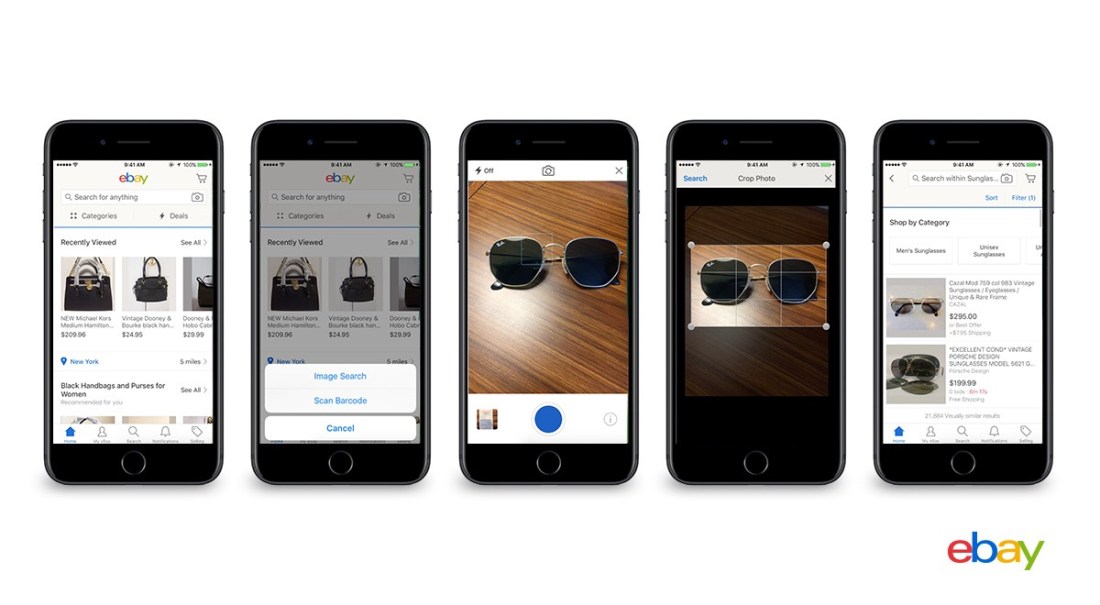
Visual search allows you to take a photo and upload it to a search engine like Google or Bing. Then, the search engines will generate results that closely match your object.

5 ways to optimize for visual search

Visual search helps leads find your products. There are seven ways you can help your business optimize for a visual search to drive more leads.

1. OFFER NUMEROUS IMAGES

When you optimize your business’ site for visual search, offer numerous images for your products. You don’t want to just rely on one image. It could cause leads to miss out on your product and choose a competitor’s product instead.

Multiple images ensure that your leads find your products regardless of the angle they view your product. If they take a picture of the product from the back, they should be able to find a back-facing photo on your website.

By taking multiple photos of your products, you’ll ensure that your audience finds your website first. This will help you earn more valuable leads for your business.

2. CHOOSE HIGH-RESOLUTION PHOTOS

If you want to attract leads through visual search, you need to invest in great photos. High-quality photos ensure that Google can process your photo to match a person’s search query.

Resist using blurry or low-resolution pictures on your site, as they aren’t appealing to your audience and make your site seem unprofessional. Not to mention, your audience will have a hard time getting a closer look at your product.

High-resolution photos ensure that your audience sees your product clearly. It will keep your audience more engaged and interested in your product.

3. DO KEYWORD RESEARCH

Not only is keyword research important to search engine optimization (SEO), but it also impacts visual search. Keywords help you provide a better description of your product image. It helps your image appear in the right results.

Keyword research will help you find the right keywords for your campaign. There are numerous keyword research tools you can use to help you find the right keywords for your campaign.

When you select keywords, you generally want to focus on long-tail keywords. These are keywords that contain three or more words. Long-tail keywords are more specific and detailed, so they attract more qualified leads.

4. OPTIMIZE IMAGE TITLES AND DESCRIPTIONS

Once you have your long-tail keywords selected, you’ll want to integrate them into your image title and description.

Keywords in your description help signal the subject of the image. Your audience will be able to find your products faster, and it’s helpful for people who are visually impaired. They can use screen readers to read your image’s description and understand what’s in your image.

When you create your title, make it descriptive. A generic file name like “img203.png” won’t help Google or your audience. It is best to create a descriptive heading and detailed description to help your audience and Google understand your image better.

5. ADD ALTERNATIVE TEXT

When you upload your images to the web, include alternative text, or an alt tag, with your image. An alt tag is a great place to input information about your photo, and every image you upload should have one.

Like your descriptions, this is also important to include for members of your audience that may be visually impaired. They can use screen readers to read the alt tag and understand your image better. It’s a great way to provide an accurate description of your image for your potential customers.

Alt text also helps search engines understand the context of your image. They will rank your photo appropriately because they will know the context of the image. It’s a great way to help more valuable lead find your image.

Top 5 Reasons (and solutions) for Shopping Cart Abandonment

Without understanding why customers abandon carts, it is impossible to reduce cart abandonment.

We’ve collected the top 10 reasons for cart abandonment. We’ll be breaking down each cause in detail, and provide a quick overview of how you can eliminate cart abandonment and recover sales.

Cart abandonment is a problem. The average eCommerce store loses over 75% of its sales to cart abandonment. Some industries experience average cart abandonment as high as 83.6%.

Given that cart abandonment is such a problem, it is no surprise that there have been countless studies as to why visitors add items to their cart just to leave your site without making a purchase. 

Reasons (and solutions) for Shopping Cart Abandonment

1. Unexpected shipping cost

Hidden costs are the primary reason your visitors leave without purchasing, ranking first in both probability and impact.

25% of customers specifically cited shipping costs as the primary reason driving them away.

However, you should also pay heed to other hidden costs such as taxes or required complementary items which have a similar effect.

These costs cause immediate annoyance and irritation. In some cases, it can even propel consumers to feel remorse for purchasing.

The solution??

Fully disclose costs. Transparency is valued highly by digital shoppers and is crucial for store success.

The best course of action is to state all costs from the outset.

Another successful strategy is to bundle the extra cost of shipping into the product and offer “free” shipping to the customer. CPC strategy found that free shipping is deemed “critical” to 73% of customers to make a purchase and will encourage 93% of shoppers to buy more online.

2. Having to create a new user account

Your customers expect convenience. Customers want to do things quickly and have instant results.

Spending more time and effort than expected is a significant source of friction. 22% of cart abandoners do not complete their purchase when they are required to create a new user account, and 28% of all shoppers say that it is a reason why they’ve abandoned carts.

The solution??

To state the obvious, don’t force first-time buyers to create an account before they can complete their order. Offer guest checkout.

Additionally, take some time and identify other points of friction in the checkout process that may be causing customers to spend more time and effort.

3. Conducting research to buy later

Some cart abandonment is impossible to eliminate.

eCommerce web behavior evolves. One online shopping habit is to use the internet to browse multiple products across shops. The research includes looking into the price, quality, shipping, and special offers.

Often, customers will add items to a cart in order to easily reference items. It is not uncommon for customers to exit a store with the full intent of coming back. In fact, many will return several times before making a purchase.

The solution??

While there isn’t any solution per se to reducing this type of cart abandonment – you can do better.

The point of reducing cart abandonment is to recover lost sales. If you know shoppers are evaluating certain products on price, you can implement a price match guarantee pop-up to ensure customers ultimately purchase from you.

This line of reasoning extends to other types of guarantees, such as durability, quality, or money-back offers.

4. Concerns about payment security

Payment security is the first cart abandonment reason that has a major disparity between its probability and impact rating.

It makes sense.

When you are concerned about security, it has a dramatic effect.

Major causes for suspicion include design flaws, outdated layouts, missing images, and no SSL certificate.

The solution??

There are many ways you can increase trust on your site.

The easiest method is through various forms of social proof to assure customers that you are a trustworthy store. 

Use customer testimonials. Use product reviews. Use endorsements. Provide full contact information, such as a phone number and even faces and bios of you and your workers.

All of these factors let your customers know they are working with a real person who cares about their experience and will take care of their personal information.

5. Long and confusing checkout

This top 5 reason for cart abandonment is similar to number 2 (creating a new user account).

Long and confusing checkout processes are annoying to customers. Oftentimes, unnecessary forms contribute to unease and can even become confusing. All of this contributes to a poor experience, resulting in 28% of shoppers abandoning their carts.

The solution??

Minimize form elements. Only ask for the necessary information.

Additionally, streamline your site’s navigation. Reducing the “number of screens” from initiation to completion is a great way to reduce time.

5 Highly-Effective Ways to Increase the Average Order Value of Your Online Store

You launch your eCommerce business and you’ve been able to consistently market and sell your products. But eventually, you notice something. Nearly all of your orders average out to the same, low amount.

Your store looks like it’s on the verge of plateauing, and your revenue begins to look static every month. What gives? You know one remedy is to get more traffic and thus, more orders on your website. But for some store owners, that can mean more work and more money and leaves them constantly running on the acquisition treadmill.

What is the average order value?

Average order value (AOV) is the average amount of money each customer spends per transaction with your store. You can calculate your average order value using this simple formula: Total revenue/number of orders = average order value.

How to increase average order value

1. Provide product recommendations

Occasionally, customers are so focused on buying one of your products that they neglect to browse around to find more. This leads to smaller carts, and as a result, smaller average order values.

To address this problem, try adding product recommendations to your product pages or checkout page. By profiling popular products, or products that other customers purchased in addition to what’s currently in the user’s cart, you can not only minimize friction before checkout but also increase average order value.

2. Upsell or cross-sell complementary products

Much like the previous strategy, this tip involves adding product suggestions to your product page. In this case, instead of simply suggesting other popular items from your store, hand-pick products that pair well with the item in the user’s cart, such as accessories or add-ons. For example, a mouse for a laptop, or batteries for remote control.

This is essentially cross-selling and upselling. Cross-selling is when you promote a complementary product, whereas upselling is when you promote a product upgrade or a more expensive version of the product.]

3. Set order minimums for a discount

You can also increase your average order value by incentivizing customers to spend a minimum amount. This could be a minimum order amount for free shipping, which is easy to set up in Shopify.

4. Set up a customer loyalty program

If your store sells consumable products—something customers need to repurchase, like razors or shaving cream—consider setting up a rewards or loyalty program.

Creating a customer loyalty program is a retention strategy that helps you forge relationships with your customers, which will eventually encourage customers to purchase again.

Loyalty programs can also help increase the average order value of your store.

5. Bundle products or create packages

If you want customers to purchase more items, try creating product bundles that cost less than if the same items were purchased individually.

By bundling products, you’re increasing the perceived value of a customer’s purchase. One great approach to product bundling is by offering a package of products that create the all-in-one solution for the desired experience.

Sell more to people who want to buy

The most cost-effective and efficient way to increase average order value is by concentrating on your existing, most loyal customers. They already know and trust your brand, all you have to do is get them to spend a little extra.

When you focus on engaging and activating those who are already spending with you, you have fewer barriers to overcome. Instead of spinning your wheels on the acquisition, focus on creating a greater exchange of value—the customers who spend more, get more.

5 Niche Market Examples for your eCommerce

Ever hear the expression, jack of all trades, master of none? It essentially means that a generalist can do everything decently, while a specialist does one thing extremely well. The same holds true when you’re selling online.

Carving out a niche market and positioning yourself as the go-to brand for a specific audience not only establishes your credibility over competing generalists but also results in a more focused business, from your unique value proposition to your content marketing, that makes it easier for the right customers to say, “This is for me.”

What exactly is a niche market?

A niche market is a segment of a larger market that can be defined by its own unique needs, preferences, or identity that makes it different from the market at large.

For example, within the market for women’s shoes are many different segments or niches. Shoes for vegan women would be a niche market, as would shoes for plus-sized women, shoes for nurses, and shoes for transgendered people. These are all niche markets within the larger market for women’s shoes.

Nearly every market can be further refined, or divided, by the particular needs and preferences of its constituents. Some of the most common ways to define a niche are based on:

  • Price (e.g. luxury, moderate, discount)
  • Demographics (gender, age, income level, education level)
  • Level of quality (premium, handmade, economical)
  • Psychographics (values, interests, attitudes)
  • Geographics (residents of a certain country, city, or even neighborhood)

Choosing to focus on a niche is a strategic business decision to serve a certain customer base better than competitors who target the larger market.

8 niche market examples

1. Conscious consumers

Sustainability has become a hot topic among consumers of late. According to a survey by Neilson, 48% of U.S. consumers say they would “definitely” or “probably change” their consumption habits to reduce their impact on the environment.

The rise of the conscious consumer has paved the way for vegan, eco-friendly, and cruelty-free variations of conventional products. If there is a product that is frequently purchased by the mass market, there is likely a niche of conscious consumers that will embrace a greener alternative.

In the past, companies looking to appeal to this niche market might donate a portion of proceeds to a cause, but now most consumers care about how the products are sourced and produced as well.

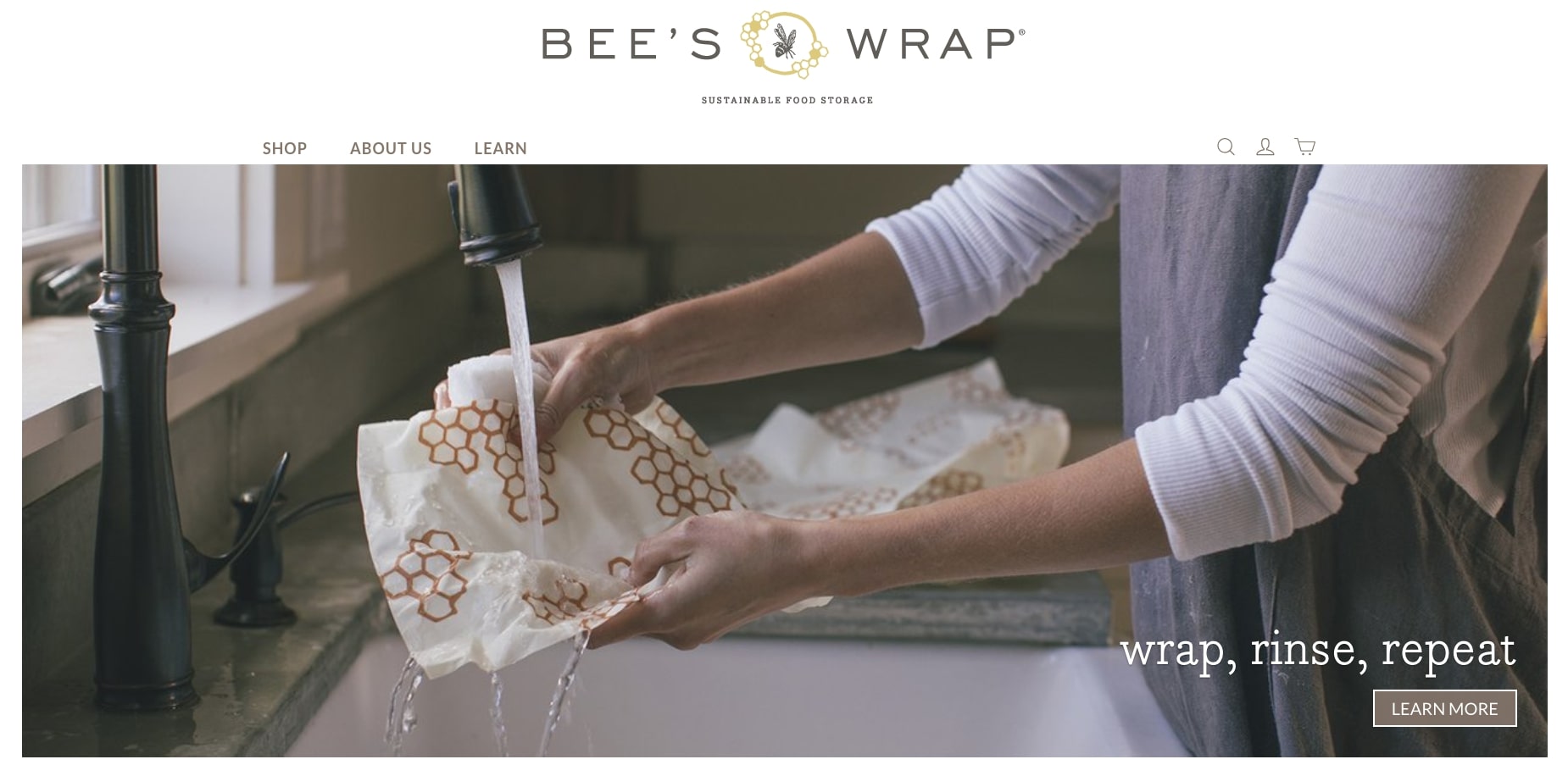
Bee’s Wrap, for example, is looking to replace plastic wrap with options made from beeswax. The natural alternative to food storage is not only environmentally friendly but also more cost-effective for consumers because they’re reusable.

bee's wrap is an example of a niche market business

More niche product ideas for conscious consumers

  • Reusable drinking straws
  • Cruelty-free cosmetics
  • Vegan-friendly apparel
  • Menstrual cups

2. Pet owners

Total expenditures for the pet industry in the U.S. alone is an estimated $75.38 billion in 2019. There’s a lot of opportunities to develop a niche within this market, across different types of pets, lifestyles, and more.

Patricia’s Couture has carved its own niche in this market—they sell personalized kaftans, pillows, pajamas, blankets, and other items you can plaster your beloved pet’s picture on. patricia's couture lets you print pictures of your pets on their productsWhile most people own fish, dogs, or cats, there are also unique pets like horses, lizards, turtles, and even chickens, each with their own potential opportunities.

More niche product ideas for pet owners

  • Pet cameras to watch and interact with pets while you’re not at home
  • GPS pet trackers
  • Personalized products with pets’ photos
  • Organic pet food and treats
  • Pet accessories and clothing

3. The LGBTQ+ community

The LGBTQ+ community is huge, and these consumers have unique shopping habits. Per Nielsen, they go shopping 10% more than the average American consumer—and they’re also willing to spend about 7% more.

Brands who make authentic connections with this market are in the best position to serve this niche. Just ask TomboyX, an underwear brand that started in this market. Originally a T-shirt brand, co-founder Fran Dunaway saw the opportunity to hone in on a specific consumer group’s needs to sell underwear “for anybody”.

tomboy x serving the lgbtq+ niche

More niche product ideas for the LGBTQ+ community

  • Makeup specifically designed for certain skin types
  • Pride-inspired designs
  • Clothing made for certain body types

4. Travelers

Online sales in the travel industry increased by more than 10% in 2018, amounting to $694.41 billion spent. Coupled with the declining cost of air travel over the last three decades, a more mobile consumer means tons of niche audiences to tap into, from the frequent business traveler to the remote worker struck with wanderlust.

Even the way consumers approach traveling is evolving. In fact, travelers are becoming more environmentally conscious. According to Booking.com, more than half seek sustainable options but have difficulty finding them.

This gap represents a massive opportunity for brands to step up to the plate and support eco-friendly initiatives through sustainable products. And travelers are seeking more than just green options. They also look for authentic local experiences, convenience, and long-term trips.

CNN reports that by 2020, nearly half the UK and U.S. workforce will be freelance, and at least 40% more children were home-schooled in 2017 than in 2014. This opens the doors to longer, more immersive trips, especially for remote workers who leverage their flexible careers to see the world.

Nomatic is a luggage brand geared towards travelers, but especially digital nomads that prioritize functionality. You can see this audience focus represented across their entire business, from their product to their copywriting.

nomatic as an example of a business targeting a niche market of travelers

More niche product ideas for avid travelers

  • Smartphone accessories for traveling content creators
  • Practical and comfortable athleisure for frequent flyers
  • Scratch maps for people who love collecting travel experiences

5. Gamers

“Gamers” is a catch-all term that contains a variety of subsets: mobile gamers, PC gamers, console gamers, table-top gamers—the list goes on. There are more than 2.3 billion active gamers across the globe, and nearly half spend money on their hobby, amounting to an industry worth $137.9 billion in 2018.

Shazim Mohammad launched his online store, Glorious PC Gaming Race, with products specifically aimed at PC gamers. It’s become a 7-figure business that basically runs on auto-pilot.

selling to a niche market of pc gamers

Mobile gaming, in particular, is taking over, accounting for 91% of the market. Plus, more females are entering the market than ever before, a trend which doesn’t show any signs of slowing down.

Within this category, you can also niche down based on popular genres (like first-person shooters), or consoles (like the Nintendo Switch).

More niche product ideas for gamers

  • Ergonomic products for long gaming sessions (controllers, chairs, blue-light blocking glasses)
  • Decals to personalize consoles, controllers, etc.
  • T-shirts referencing aspects of gamer culture
  • Accessories for mobile gamers

The 10 Best Tips to Improve Your eCommerce Facebook Ad Campaigns

The ecommerce landscape is incredibly competitive with new ways to sell products online continually becoming available. Businesses everywhere must actively seek out new methods to find customers and cut through the noise.

While it’s not new, Facebook provides an excellent opportunity for ecommerce stores and businesses to do this. With 2.41 billion monthly active users, the largest number of ecommerce orders from a social media platform, and a typical ROI from Facebook Ads at 152%, ecommerce Facebook advertising is a goldmine for businesses.

If you’re looking to build or reinvent your ecommerce advertising strategy on Facebook, these 10 tips will get you started.

10 Tips to level up your ecommerce Facebook advertising campaigns

1. Create the perfect image

Your ad’s image is the very first thing users see, so it’s essential that it’s both attention-grabbing and aesthetically appealing. Some components to keep in mind when designing your ad creative include:

  • High-quality — Ecommerce Facebook ads should be scroll-stopping images that stand out in the newsfeed. Instead of stock imagery that often get overlooked, use professionally-shot, beautiful representations of your product in real-life situations:
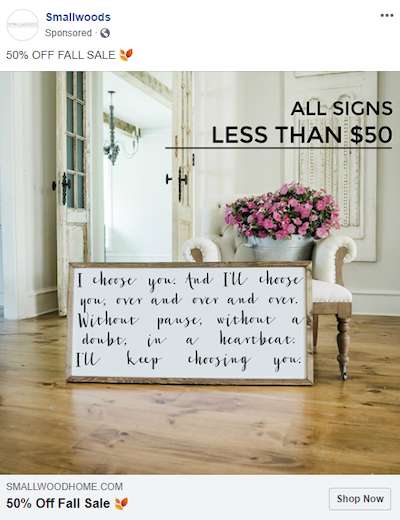
ecommerce Facebook advertising image tips

  • Faces — Humans connect best with other humans, so welcoming, personal, emotive faces are ideal for catching attention and allowing individuals to visualize themselves using your product:
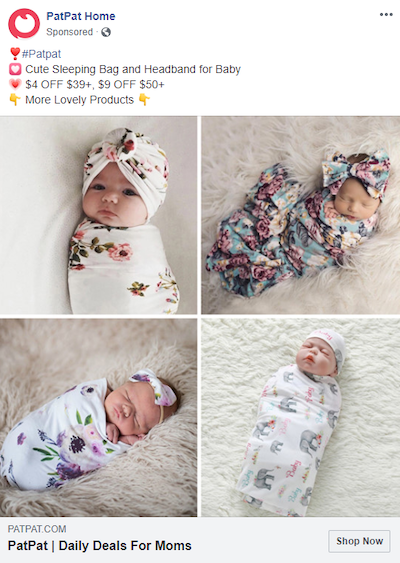
ecommerce Facebook advertising images faces

  • Simplicity — Overly complex images with distracting elements take attention away from your product, while simple images with empty space can draw more focus to your product:
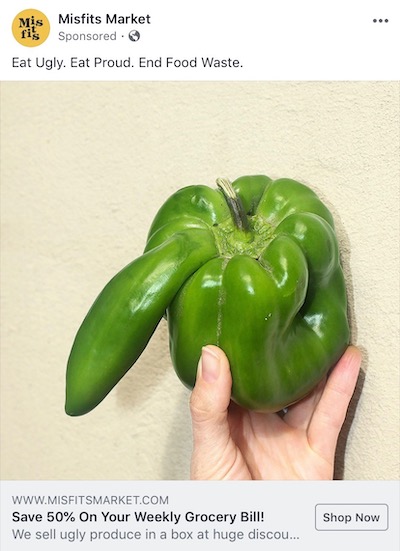
ecommerce Facebook advertising images simplicity

2. Use Carousel or multi-product ads

Multi-product or Carousel Ads give advertisers the ability to show several products (or different features and benefits of one product) in a single ad — each with its own image, description, and final URL:
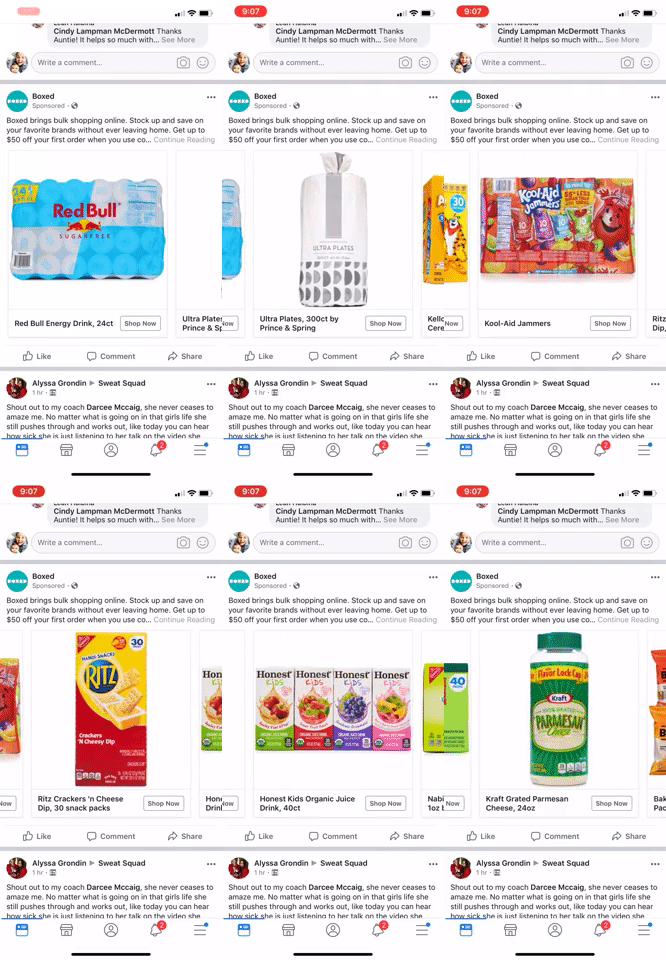
ecommerce Facebook advertising tips Carousel Ads

Since these ads give users more options to choose from, there’s a higher chance a product will be relevant to them, and a greater chance of you earning a conversion.

Studies have proven that multi-product ads can be more effective and efficient than single-image ads. Adobe, for instance, found that this ad type generated:

  • Up to 300% increase in CTR
  • 35% reduction in CPC as a result of higher engagement
  • More efficient CPA

3. Install conversion tracking pixel

A common frustration among business owners is knowing whether or not their ads actually performed well. You can boost a Facebook post, or even set up an entire ad campaign, but without installing the Facebook Pixel you won’t know if it drove any sales.

Facebook’s conversion tracking pixel — a small snippet of code that tracks visitors’ behavior on your site — is the connection point between your Facebook ads and website:
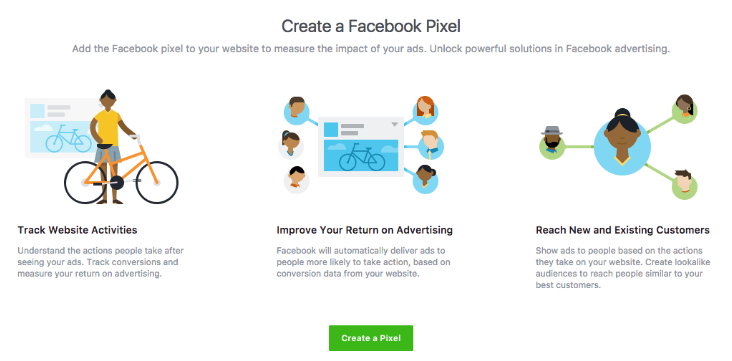
ecommerce Facebook advertising tips tracking pixel

It shows every action taken by visitors on your site, who arrived there through your Facebook ads. Essentially, it tells you not only if your ads drove results, but also which audiences and ads those conversions came from. Another reason to install the pixel is because the platform uses it to improve Facebook ad campaigns.

4. Communicate your brand story

Since Facebook is first and foremost a social network, and not necessarily an online store, most people are there to connect rather than shop. This makes it extremely important to connect and build relationships with prospects before rushing a sale.

You can do this by communicating your brand’s story and identity, or how you want your brand, business, and products to be perceived by customers. Use Facebook ads to show your target audience what you’re all about, and once you’ve built a solid identity for your brand, people will instantly recognize it and be more likely to purchase.

One case study that supports this idea is Adaptly, who ran two Facebook campaigns side by side and saw drastic differences. One campaign focused strictly on generating subscriptions right from the beginning, while the other told the brand story first, then provided product information, and finally inviting people to sign up:
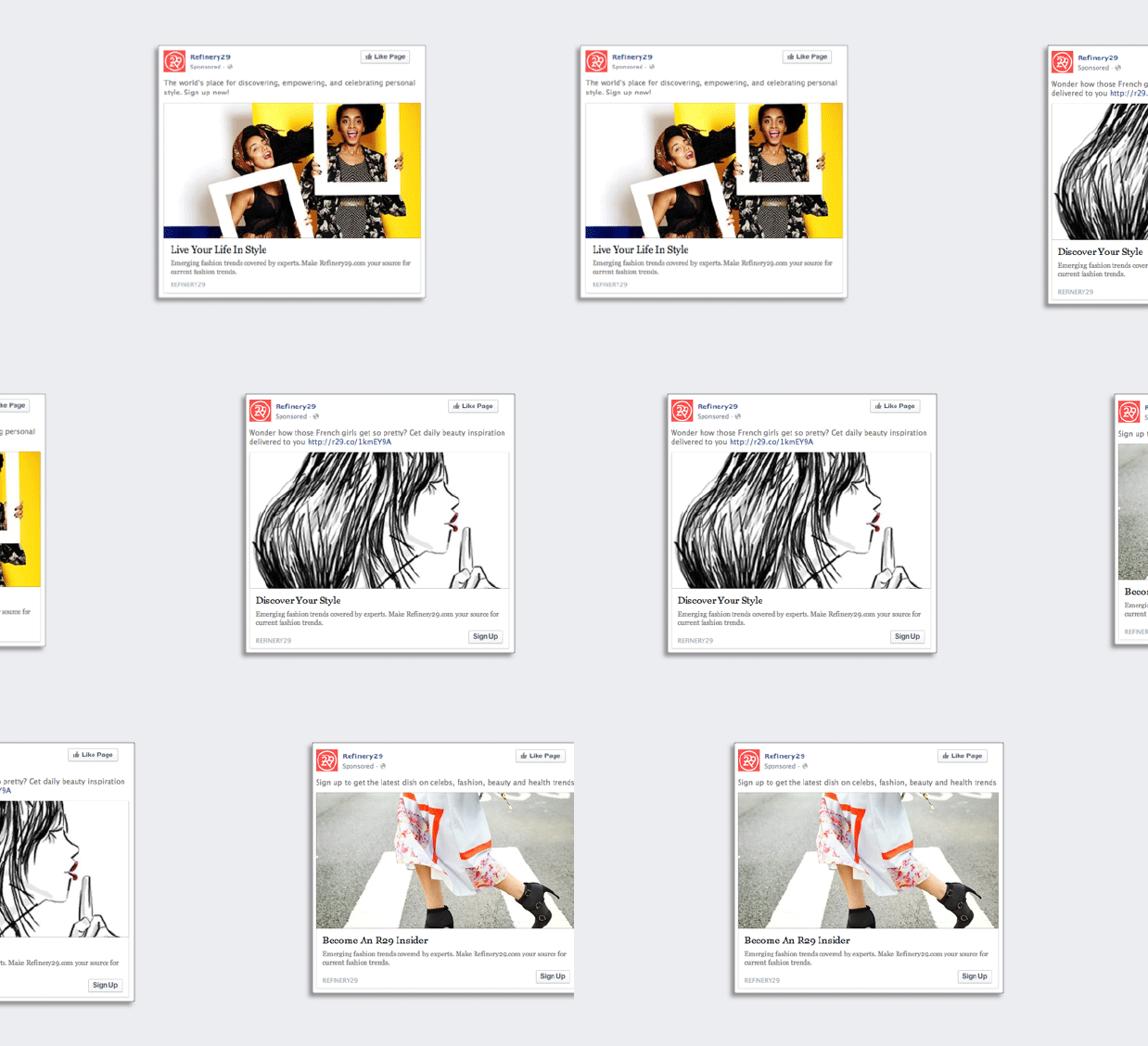
ecommerce Facebook advertising tips adaptly brand story

Adaptly’s research had three major findings:

  • An 87% increase in post-click landing page traffic when people were exposed to the sequenced ads.
  • Subscription rates increased by 56% among people exposed to the sequenced ads.
  • People exposed to all three of the sequenced ads converted at higher rates than those who had seen just one or two of the ads.

These results indicate that telling your brand story before asking people to purchase can help build trust, establish a reputation, and therefore, increase people’s receptiveness to different ads.

Telling your brand story can be done in many ways, some of which include:

  • Showing how/where the product is made
  • Discussing how the product idea was discovered
  • Interviewing people who make the product

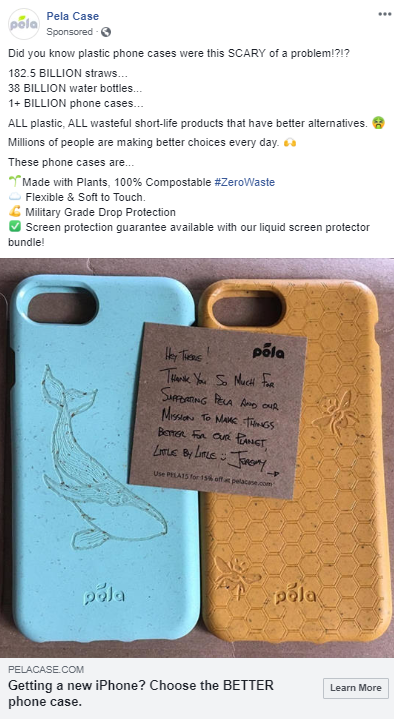
For example, Pela Case uses the ad below to tell prospects why they make these specific phone cases, instead of immediately pushing for a sale:
ecommerce Facebook advertising tips brand story

5. Use dynamic product ads

One study shows that nearly 76% of online shoppers abandon their shopping carts without completing a purchase. It’s slightly worse on mobile, with abandonment rates reaching almost 78% for mobile users. With retargeting, though, sites can bring back about 26% of abandoners, and increase their conversion rates by 70%.

This is why dynamic product ads are vital for Facebook ecommerce advertising.

They are one of the most common Facebook ad formats in the ecommerce landscape — and one of the highest ROI strategies ecommerce sites can use — because they serve as a chance to bring back that 76-78% of hesitant customers that left without purchasing.

Dynamic product ads pair your Facebook pixel data and product catalog to retarget potential customers and show them tailored ads based on their site activity.

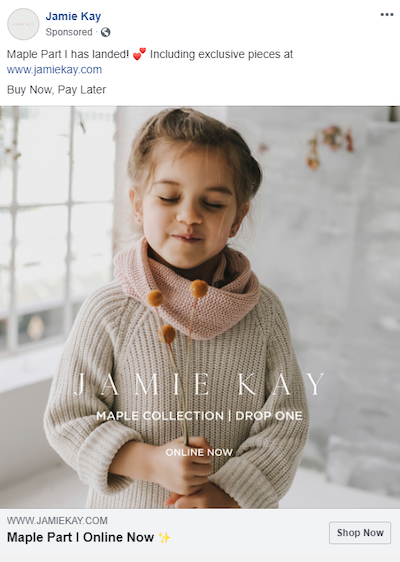
Take Jamie Kay, for example, who showed me this ad after spending quite a bit of time on their website and putting too much in my shopping cart:
ecommerce Facebook advertising tips dynamic product ads example

These types of ads don’t require advertisers to create ads for each catalog product either, because Facebook templates will pull images, product names, pricing and other information from your catalog based on product details you upload to Facebook.

6. Create Custom Audiences

Custom Audiences are another way to tap into the data captured by your Facebook pixel and retarget the right people — those who have already shown interest in your brand. When creating a Custom Audience, the three main sources for ecommerce brands include:

  • Customer file — This allows you to upload a list of email addresses, phone numbers, and any other contact information collected from customers or leads. Facebook then matches this information to its own users so you can target them directly. Creating an audience this way is ideal for re-engaging past customers with new products or reaching email subscribers who haven’t purchased yet.
  • Website traffic — This allows you to create retargeting lists of previous website visitors, based on actions taken or website pages visited. Retargeting lists that generally convert best in this case are those who visited your website in the past 30 days or added something to their cart in the past 7 days.
  • Engagement — This provides you with a list of various engagement types by which you can retarget. Whether you have a video on your Facebook Page collecting thousands of views or an event with a ton of attendees, any positive engagement indicates that someone might be interested in your product, and are therefore worth retargeting.

7. Lookalike Audiences

This is a great feature to use because it helps you find new customers based on previous customers’ characteristics. So you’re advertising to people who are similar to your existing customers, and more likely to be interested in your products as well.

In fact, Lookalike Audiences are usually one of the highest performing target groups for many advertisers.

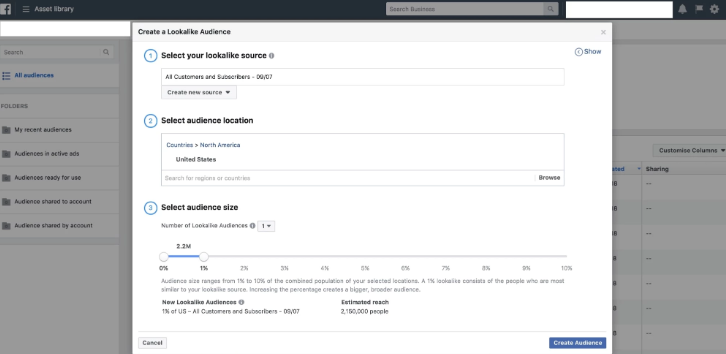
The feature uses data from Custom Audiences to create a new audience, ranging in size and likeness from 1% to 10% of a selected population:
ecommerce Facebook advertising tips Lookalike Audiences

A 1% Lookalike Audience contains people who most closely resemble the Custom Audience source. As you expand your targeting and increase your ad spend– eventually moving to a 10% Lookalike Audience — you get more scale while still remaining close to a user profile that matches your existing customers.

Naturally, the larger and more detailed your customer list, the more accurate your Lookalike Audience will be.

Using the Lookalike Audience feature allows advertisers to personalize their content. Since you already know what your audience responds well to, you can provide them with experiences they’ll appreciate more and be likely to convert on. In fact, 80% of shoppers are more likely to buy from a company that offers personalized experiences, so brands should be tailoring experiences as much as possible.

8. Get creative with offers

Discounts
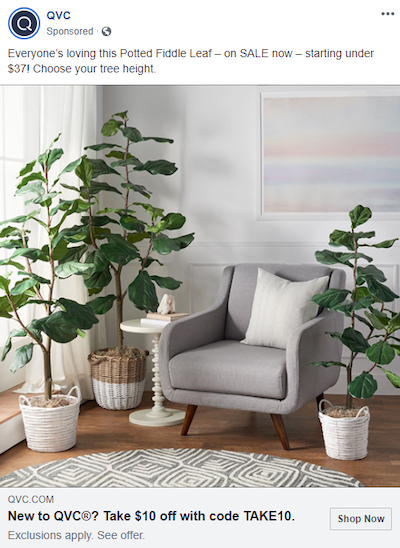
People love discounts so much that someone who is not actively looking for a product might end up purchasing it just because it’s on sale. So it’s worth testing advertisements that highlight a discount as part of your ecommerce Facebook advertising strategy. Similar to QVC here:
ecommerce Facebook advertising discount code example

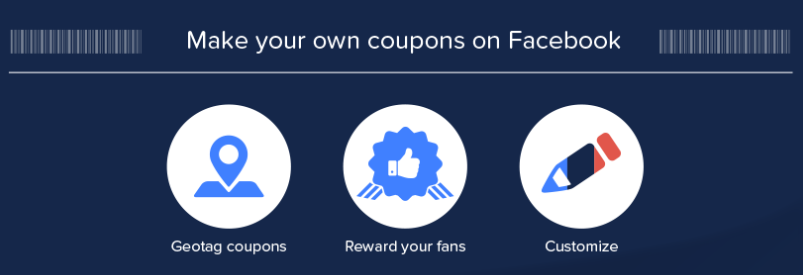
Facebook even has an app to offer your followers coupons for exclusive discounts or even free items:
ecommerce Facebook advertising tips coupons

These Facebook coupons help:

  • Drive traffic and conversions
  • Encourage more people to sign up as fans
  • Build loyalty with existing followers

Offers
The Offers feature within Facebook ads allows you to minimize the gap between the discount offer and the actual sale where you can lose customers, because they don’t even have to leave Facebook to redeem your offer. They get a code as soon as they click the Offer ad.

Another advantage is that you can show the number of people who have taken advantage of the offer. This serves as social proof — “If others are enjoying the benefits of the offer, then why shouldn’t I?”

Contests & giveaways
Contests and giveaways may seem counterproductive to driving sales, but they can be quite powerful in the long run if you use them strategically.

First, they help build brand credibility and loyalty. If prospects know you’re not all about the sale — but also willing to appease them (with contests and giveaways) — they’ll likely keep you on their radar and be back to purchase down the road.

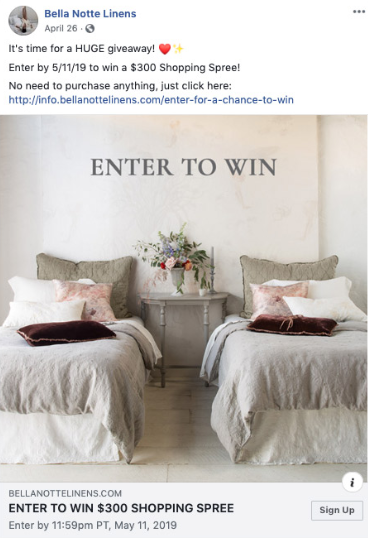
Not only that, but it’s a great way to draw people in. Take this ad, for example:
ecommerce Facebook advertising contest example

The winner of that $300 would likely end up spending more than $300 on the shopping spree. And if someone saw this ad and didn’t win, the visually appealing image may have still been enough to make them want to shop here.

9. Create urgency

No matter what type of ad you decide to create, always include powerful words and phrases that encourage action now.

For instance, people are highly susceptible to language that incorporates a sense of urgency. So if you already know your prospect is interested, push them towards a purchase with copy such as:

  • Flash sale
  • Limited time only
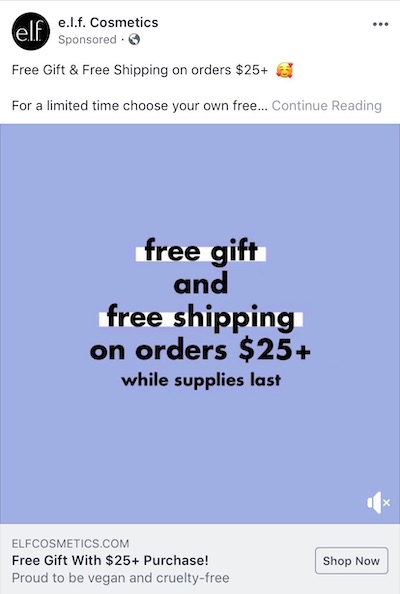
  • While supplies last
  • Hurry
  • Don’t wait
  • Buy now
  • Don’t miss out
  • Offer expires
  • Act now
  • Clearance
  • One day only
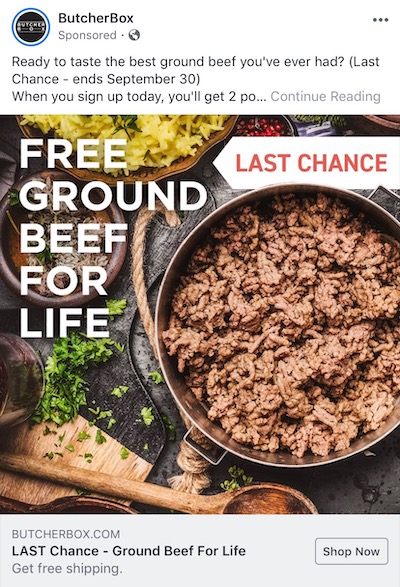
  • Last chance
  • Deadline

Here are a few great examples:

ecommerce Facebook advertising tips urgency flash sale

ecommerce Facebook advertising tips urgency limited time

ecommerce Facebook advertising tips urgency deadline example

10. Create a funnel

When it comes to ecommerce Facebook advertising, the confusion can start at the very beginning, because many people look at the objectives offered on Facebook and immediately go for the conversion.

While sales are the ultimate goal, the vast majority of people aren’t ready to buy your product the first time they see it. High-value conversions typically occur after a user has interacted with your brand over multiple touchpoints.

A three-step funnel-based approach to advertising is recommended to tailor your ads to users’ familiarity with your brand and intent to purchase. The three sales funnel stages are:

Brand awareness

If users don’t know who, they’re not likely to buy from you. By starting with a brand awareness campaign, you’re casting a wide net on the platform, getting your brand and product in front of as many Facebook users as possible.

In these campaigns, start with a low-commitment offer used merely to inform your audience of how you can help them, not necessarily aiming for a sale yet.

Once they know who you are and what you offer, then proceed with more engagement.

Engagement

The more positive engagement from an ad, the more likely other viewers are to stop and interact with it, too. That’s why engagement campaigns come immediately after brand awareness campaigns.

Valentina Turchetti, Founder of YourDigitalWeb, explains:

In the second phase, Engagement, my goal is to establish a relationship with the fans of the page. The goal is to receive likes, comments, shares, and maybe questions about how to buy the product or the service. In an engagement campaign, I usually use a video ad that immediately highlights the benefits, the advantages and/or the main strengths of a product or a service.

Click/conversion

Following the previous two touchpoints, advertisers can solicit higher commitment engagement — clicks and/or conversions.

Brandon Thurgood of Disruptive Advertising takes this approach:

We can now take this audience of people who have engaged with our ad and put them into a traffic campaign that we can optimize for landing page views. At this point, our goal isn’t just to increase brand awareness — we also want them to visit a page on our site.

What tips will you use in your ecommerce Facebook advertising?

Using these ten tips in your Facebook advertising will help give your ecommerce business a boost — improving your chances of more sales and generating more ROI.

See where else you could generate conversions by downloading the Marketer’s Guide to New Optimization Opportunities here.

Best eCommerce Marketing Automation Platforms

The marketing automation industry has skyrocketed from a $500m market to an expected $6.4bn in 2024. According to Salesforce’s State of Marketing Report, 67% of marketing leaders are already using at least one marketing automation platform and a further 21% planned to start using one.

At the same time, the list of marketing automation platforms continues to grow with new tools hitting the scene every year, making it harder than ever to find the right platform for you.

Top eCommerce Marketing Automation Platforms

Wigzo

wigzo

Wigzo is a marketing automation and analytics tool, designed for eCommerce, allowing them to send 1:1 personalized communication tailored to each individual user across all channels.

It is a comprehensive marketing automation solution, with the ability to send triggered, and segmented notifications, emails, and SMS.

ActiveCampaign

Active_Campaign

ActiveCampaign is used by over 90,000 small businesses and is one of the overall best marketing automation platforms. They were also the first to pioneer the visual automation sequence builder.

Hubspot

hubspot

Pretty much everything that Hubspot offers can be found elsewhere at a much lower cost. And yes, while it is true that Hubspot does offer a free version of their software, this doesn’t include any of their marketing automation features. If you’re looking to use Hubspot for marketing automation, you’ll need to cough up at least $800/month (paid annually), plus an additional $3,000 in onboarding fees. In other words, if your marketing automation budget is below $12,600/year, you may want to move on to our next suggestion.

Rejoiner

rejoiner

Our final contender is for those wishing to delegate the management of their marketing automation to a team of experts.

Rejoiner is a managed marketing automation platform. Unlike most tools where you pay your subscription fee and must then figure out how to use the tool to grow your business, Rejoiner shares this accountability.


5 Best Growth Hacking Tools For eCommerce

A growth hacker is only as good as the tools he has.

With the right tools, a growth hacker is able to run rapid experiments across the entire marketing funnel, identify the right tactics that work, and scale them up efficiently.

What this means simply is – a growth hacker must constantly be on the lookout for the best tools on the market, those that can help them do his/her job better.

That’s why I’ve compiled 10 of the best growth hacking tools that you can experiment with to make your marketing processes more efficient.

These are tools I’ve used personally to acquire more customers, retain them or simply to scale certain tactics.

To help you get started fast, I’ve also added tactics that you can test immediately with each tool.

Best Growth Hacking Tools For eCommerce

1. Audiencefy

Audiencefy

Audiencefy is the best customer segmentation and eCommerce analytics app. That will help you grow your Shopify sales and exponentially increase eCommerce revenue. Audiencefy integrates with your Shopify store to automatically populate customers’ order information, individual customer data, and journey, analytics, insights and more.

Top Benefits:

  • Executive Summary of Your Store
  • Predefined Customer Segment
  • Individual Customer Data & Journey
  • Order & Product Analytics

2. Colibri.io

collibri_growth_hacking_tool-600x168

Colibri is one of the best tools to scale up your traffic. It helps you to get in front of your audience. Colibri increases the results of your SEO efforts and enhances your online visibility.

Top Benefits:

  • Lets you know about conversations with your audience.
  • Provides information about people searching your competitors
  • SEO driven tool that allows you to make changes in your online marketing.
  • Shows you where customers are engaging online, so you can insert yourself into relevant conversations.

3. ClickToTweet

clicktotweet-growth-tools-720x325

Click to Tweet allows you to promote your business on Twitter with a single click. This tool can be used in many ways. You can offer your audience to promote it on twitter in exchange for a gift or a free service.

Top Benefits:

  • Promotes social media sharing.
  • Tells you the exact number of times people have clicked on your tweet.
  • Easy to integrate into a variety of online resources, such as email, landing pages and social media posts.

4. Pay with a Tweet

PaywithaTweet

Pay with a Tweet is a tool that is also geared towards content and/or product promotion via social media. This growth hacking tool makes it possible to see certain content only after you have shared the website via social media.

Top benefits:

  • Encourages social media sharing
  • Invite visitors to pay their posts via Facebook, Google, LinkedIn, and Xing.
  • Customizable to your own brand.

5. Outbrain

outbrain-growth-tools

Outbrain enables you to reach new audiences and get your brand discovered on networks such as CNN, TIME, Slate and Fast Company.

Top Benefits:

  • Get your brand featured on CNN, ESPN and People and other top companies.
  • Turn-key set up and optimization in the amplify dashboard.
  • Outbrain dedicates a significant amount of human, capital and technology resources towards making sure everything we advertise is 100% safe and trustworthy.
  • Outbrain is a platform that helps you advertise.