Top 5 Best Mailchimp Alternatives for 2020

Marketers all over the world use Mailchimp for their email marketing needs. A long-time fan favorite, Mailchimp has dominated the industry for small business email marketing. However, recent events and emerging Mailchimp competitors are changing the playing field.

With significant pricing increases, including legacy pricing, many marketers are beginning to wonder if Mailchimp is the best email marketing automation solution for them.

However, there are tons of email services like Mailchimp that exist, and they’re just as good, if not better than Mailchimp. We’ve listed the best Mailchimp alternatives for you to test out for your online store.

Channels Comparison

EMAIL SMS FACEBOOK MESSENGER GOOGLE & FACEBOOK CUSTOM AUDIENCE WEB PUSH NOTIFICATIONS
Mailchimp
Omnisend
Hubspot
Aweber
Sendinblue
MailJet

Features Comparison

BEST FOR UNIQUE FOR FREE STARTED PRICE
Mailchimp Newbies Ease-of-use Up to 2000 contacts &12000 emails / month From $10 / month
Omnisend Ecommerce Omnichannel Marketing Automation Up to 15,000 emails / mo From $16 / month
Hubspot Newbies/Intermediate Native integration with HubSpot CRM (free forever, unlimited contacts) Up to 2000 email sends /month From $50/month with Marketing Hub Starter.
Aweber Newbies Ready to use stock photos No free plan From $19 / month
Sendinblue Intermediate Hyper Visual Automation 300 emails / day From $25 / month
MailJet Advanced Email marketing for developers/tech savvy people Up to 6000 emails / month (200/day) From $8.69 / month

Best Mailchimp Alternatives

1. Mailchimp Alternative – Omnisend

Get Started With Marketing Automation

Omnisend is probably the best Mailchimp alternative on this list simply because it’s so much more than an email marketing tool. Omnisend harnesses the power of omnichannel marketing by allowing you to connect several channels into the same automated workflow. This means you can save time by consolidating marketing efforts into this one platform.

With that said, email marketing sits at the core of Omnisend, and they certainly do it well. An easy to use drag-and-drop visual composer that allows you to customize nearly any element in your email. Omnisend also provides an array of pre-built templates to make email creation even simpler. They also offer interesting email capture options like landing pages, popups, and lead generation forms that you can use to build your own email list.

However, what really makes Omnisend stand out is its sophisticated automation and segmentation. Omnisend, like many other tools on this list, offers email automation complete with templates that make complex automation set up child’s play. Their advanced segmentation allows you to target your customer in a variety of ways: based on profile data, campaign engagement, and shopping behavior.

Key Features:

As one of the most complete tools on this list, Omnisend’s feature list is impressive:

  • Integration of email, SMS, Facebook Messenger, and web push notifications all in the same automation workflow
  • Smooth visual email campaign composer
  • Advanced segmentation for precise targeting
  • Personalization to increase customer engagement and loyalty
  • Email capture using popups, static sign up forms, landing pages, and gamified forms
  • Product picker for automatic importation into your campaigns
  • Ecommerce-ready elements like discount codes and customer rewards
  • Live website tracking for behavioral data and A/B testing
  • Browse and Cart Abandonment automated workflows
  • 24/7 customer service

2. Mailchimp Alternative – Hubspot Email Marketing

hubspot

HubSpot offers a reliable and feature-packed email marketing tool that’s suited for growing businesses — for free. The tool allows you to create professional marketing emails that engage and grow your audience. You can start from scratch, with the easy drag-and-drop email builder, or use one of the goal-based templates available.

HubSpot Email Marketing is automatically connected with the HubSpot CRM (free forever), so you can tailor emails (subject lines, content, CTAs)  based on any relevant details you have — such as form submissions and website activity.

Key Features:

  • Create beautiful emails, without designers or IT, using the drag-and-drop editor or select one of HubSpot’s goal-based templates.
  • You can customize emails using an email subscriber’s lifecycle stage, list membership, or any information in your contact records stored in HubSpot CRM (free-forever, unlimited contacts).
  • Maximize engagement with emails automatically tailored to each recipient.
  • Optimize email campaigns with A/B tests and analytics.

3. Mailchimp Alternative – Aweber

For Those Who Need Just Email Marketing

Aweber has long been a classic email marketing tool. In the time that they’ve been an industry leader, Aweber has perfected their visual campaign builder. They offer more templates than any other tool on this list, and each template comes with a few different palettes for even easier creation. From there, each template is completely customizable.

For email capture, you can create rudimentary popups, but exit intent isn’t possible. There’s also no hosting for the landing pages Aweber provides, so you’ll have to copy and paste codes to implement landing pages and popups on your site.

The biggest drawback of Aweber however, is what seems to be a lack of segmentation.

While there are a lot of things to add, there aren’t really a lot of options for customization. Aweber might work as a general email marketing tool, but it might be better to look elsewhere if you run an online shop.

Key Features:

Aweber’s features stick strictly to email:

  • Several templates for easy email creation
  • Very basic email automation
  • A/B Testing
  • Live support

Aweber is great if you’re looking for something hyper basic and you’re a small business. Otherwise, it might be better to look elsewhere.

4. Mailchimp Alternative – Sendinblue

Simple, But Effective

SendinBlue is a very simple, but effective and well-executed platform. Unlike some of the simpler tools on this list, SendinBlue doesn’t feel dated.

While their email builder is limited compared to some of the other tools on this list, it’s definitely one of the better visual builders I’ve worked with.

SendinBlue also integrates well with several eCommerce platforms, allowing you to segment and send campaigns based on shopping behavior alongside the standard profile data and campaign engagement.

While SendinBlue is limited to SMS and email marketing, if that’s all you need, this might be a tool worth looking into. However, if you want to provide a better experience and incorporate other channels, it might be time to look elsewhere.

Key Features:

SendinBlue’s feature list:

  • Several templates for easy email creation
  • Easy segmentation and targeting
  • Campaign personalization
  • Email capture using embeddable forms
    Complex email automation
  • A/B Testing
  • Live support

5. Mailchimp Alternative – Mailjet

Email Marketing for Beginners

Mailjet offers simple email marketing and automation for small businesses. Like many others on this list, they offer simple drag and drop visual builder. There are a lot of templates to choose from, but if I’m speaking honestly, they all tend to look the same.

The biggest flaw with MailJet is that it’s a simple tool that’s not simple to use. Some of their features feel hidden, and at times, the language around certain parts of MailJet is really difficult to understand.

Automation in MailJet is basic enough. You can automate your campaigns to send welcome emails, custom emails, and date-based emails. Apparently, anniversary/birthday emails are coming soon.

Key Features:

MailJet’s feature list:

  • Basic segmentation on campaign behavior and profile data
  • Basic automated drip campaigns
  • Embeddable sign up forms with code
  • A/B Testing
  • 24/7 support

5 Best Conversific Alternatives

Conversific is an analytics tool for Shopify that allows merchants to optimize their efforts and drive more conversion by collecting improved data.

Conversific offers a good association between websites, marketing channels, and Google Analytics. It automatically pulls and updates data from many sources.

There are a few drawbacks in Conversific such as their integration with Facebook ads is not good, it has no content focus still the pricing is very high for a Shopify Analytics tool.

So here are some better alternatives to Conversific that you can try.

Best Conversific Alternatives

Audiencefy

Audiencefy is an eCommerce analytic and customer segmentation tool to advance your marketing campaign and exponentially grow your eCommerce revenue.

Audiencefy offers robust data and insights every small venture to large organizations needs to grow their business.

Audiencefy is a one in all Ecommerce Analytics app that works with Shopify, Magento, Google Analytics, and many others to drive immense value to your Shopify store and boost your Shopify sale.

Audiencefy integrates with Mailchimp, Klaviyo, Facebook Ads, Google Analytics.

Visit Website

Try App Now

Shoppr

Shoppr with access to 40+ metrics in a single dashboard is an analytics-centered platform that offers the integrated customer view to e-commerce marketers which are usually missing and allows them to outreach to the right targeted customers with the right product at the right time.

Shoppr integrates with many eCommerce platforms like Shopify, Magento, Woo Commerce, Big Commerce, and many others and simplifies their Marketing and Growth functions with their data-driven insights and reports.

Visit Website

RevTap

RevTap is an eCommerce analytics platform that will connect with your Shopify store, marketing, and analytics tools, and convert all data into actionable to drive Shopify sales.

Revtap establishes data-driven decisions on your inventory, the discounts you want to give, the market you want to work with, and the marketing channels you select.

It also scales down your Ad expense, and your customer acquisition cost and boosts your sales and revenue.

Visit Website

Try App Now

Segments.tresl

Segments.tresl.co is a segmentation analytic platform That helps you increase repeat revenue with prebuilt segmentation and actionable insights

Segments offer innate store insights, intuitive reports, and automated segmentation for your eCommerce marketing campaigns.

Segments also integrate with Klaviyo, Mailchimp, Facebook Audience, ReCharge, ActiveCampaign, Google Audience.

Visit Website

Try App Now

Metrics Box

Metrics Box is an analytics tool that helps eCommerce businesses to automate, analyze, and optimize their businesses.

Metrics Box enables you to explore insights on all existing customer data and support customers through email, social, website, iOS, and android apps.

Metrics Box integrates with Facebook Ads, Google Ads, and Slack.

Try App Now

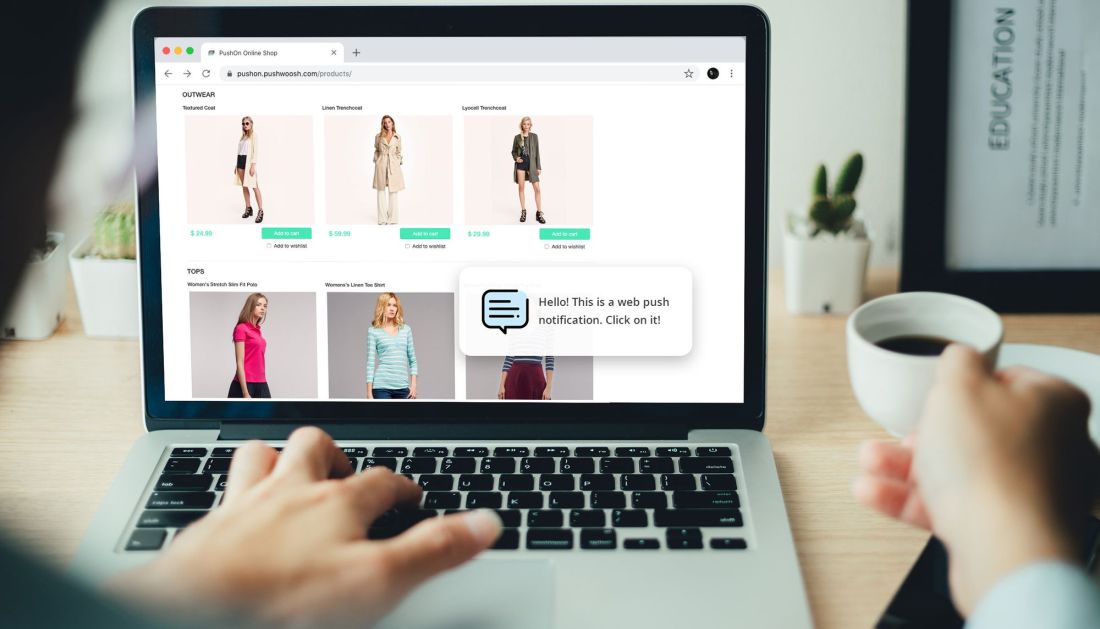
Use Web Push Notifications to Boost E-commerce Sales

If you’re already up to the task of building a list of subscribers who’d like to receive web push notifications, you might be wondering what kind of messages will keep users engaged? Below are a few ways to maximize user engagement with web push notifications.

Web push notifications are one of the easiest ways to bring users back to the website once they leave. Got a great offer? Discounts only for the next couple of hours? Be ready for an instant hike in traffic after sending a web push notification to all the opt-ins. It is a great way to retarget the users because of two reasons,

  • It demands less commitment from users to opt-in. Clicking “yes” is always easier than submitting the email id. This makes web push notifications preferable over emails.
  • Let’s be honest, retargeting is expensive. You don’t even know if your visitor wants to see you again. With voluntary opt-ins, you could be sure of user willingness to see your messages.

Leverage Push Notifications to Boost E-Commerce Sales

There are three main strategies to maximize the impact of web push notifications to increase sales.

1. Broadcast

We see many companies adopting an email newsletter- type mindset to send web push. Send a few web push notifications every day and send them to everyone.

There will always be some percentage of people who click. The question is how well does it work compared to alternatives. Much like emailing all recipients on the distribution list of your newsletter, it works. Some percentage of people will always respond. However, with web push notifications, you’re only tapping into a part of what’s possible.

2. Targeted Broadcast

Targeted Broadcast moves you toward more thoughtful messaging. The goal is to push more messages out to more subsets of your audience. Push political news to those who read political news stories vs. lifestyle. As you become more relevant, you add more value to the user in push messages which pays back.

My best advice to hone in on relevancy is to “think one layer deeper.” What I mean is think about getting someone to your site. That’s layer one. Once they click into a section or category that’s layer two. Here considering one layer deeper means focusing on layer two. Create user profiles and don’t send users a Sports news alert if they visit the Travel category 20 times in the last three months. Sports Cafe, a sports website in India uses web push notifications in a very targeted way.

3. Auto-triggered

This is where we see the leaders of the web push experimenting and generating the highest possible response rates, providing the most value.

Web push messages which are auto-triggered based on an individual’s behavior are more relevant and hence, garner higher click-through rates. Any web site that has created a series of steps for a user to walk through has the opportunity to re-engage them in a personalized way if they fall out of the process halfway through. Media and publishing companies with premium subscription services and e-commerce companies with a standard purchase process can take significant advantage of knowing who the person is, at which step in the purchase process they dropped off and can message them on how to quickly jump back in and complete purchase easily.

Boost eCommerce Sales With SMS Marketing

SMS messages with an open rate of 98% compared to only 20-30% for email, eCommerce merchants are using SMS marketing to foster good relationships with their consumers. Text messages are extremely useful when done in the right manner. This article focuses on the basics of using SMS marketing for eCommerce.

In-depth Guide on SMS Marketing for Ecommerce (FREE)

Top 5 SMS marketing strategies to generate more sales

1. Segmentation

Hyper target your customers by using segments and send them personalized text messages, just like you do in email marketing. For example, target customers for a personalized SMS marketing campaign who haven’t purchased in the last 30 days with an average order value of $40+.

2. Abandoned cart reminders

The average cart abandonment rate is as high as 75%, so you must focus to reduce it. Your customers are juggling many things at once, and it’s up to you as an eCommerce business to remind them to take action and make it easy for them to finish checking out.

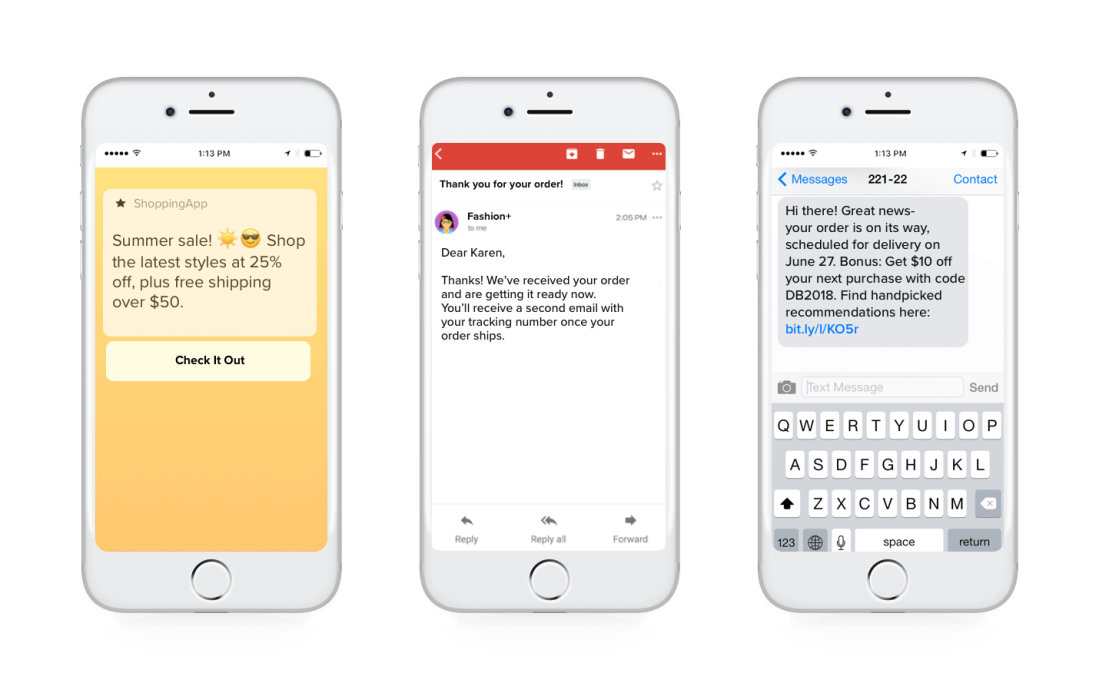
Here’s an example of an SMS cart reminder.

ecommerce-text-message-example

3. Write simple, understandable, and short messages

Get to the point and don’t make your text messages too long. Use emojis whenever possible to engage the customer and make the offering and the message that much more personalized.

4. Start a giveaway

To boost customer engagement,  successful eCommerce merchants entice their customers to join their VIP club. One of the best way is to set up is a landing page for your VIP customers to give them special offers and discounts.

loyalty-giveaway-sms-example

5. Send it at times when customers are more likely to act

Be strategic on the timing of your automated SMS marketing campaigns to ensure that you stay top-of-mind, even after the customer has left your site. Avoid sending in the middle of the night and do A/B testing to find the most optimum time to send the messages.

SMS Examples for E-Commerce Businesses

No matter where or what you sell, SMS will help you grow your eCommerce business and your bottom line. eCommerce business has seen:

eCommerce SMS Marketing Examples

Let’s dive straight into specific examples of how eCommerce marketers use SMS daily to reduce abandon cart rates, drive sales, and improve customer experience.

1. Broadcast to an Audience

Easily send a text message to your entire text subscriber list.

Drive Sales

With SMS marketing, you can create a unique SMS keyword that your subscribers can text in to receive a discount code. When your subscribers text this keyword, they’ll immediately receive an exclusive discount code that they can apply to their next purchase.

2. Send Notifications Related to a Specific Event

SMS notifications are text messages that are sent when an event occurs.

Communicate Key Order Details

Since customers typically read text messages within 3 minutes of their sending, SMS can help you instantly communicate key order details.

For example, you can send your customers text messages to confirm that their orders have shipped. Not only will this lead to happier customers, but it will also cut down on unnecessary and time-draining support interactions.

Rescue Abandoned Sales

A whopping 74% of customers abandon their carts. Recouping these sales is a top priority for the majority of e-commerce marketers. Instead of relying solely on automated emails, send them a text message reminder.

Drive Post-Purchase Reviews

70% of customers consult reviews or ratings before they decide to purchase. The problem is that generating these reviews is difficult.

SMS marketing allows you to follow up with your customers after they make a purchase. Text them a poll, asking if they’re satisfied with their items, then if they are satisfied, ask them for a review.

3. Conduct Two-way Conversations

You can enable customers to ask questions and resolve issues via 1-on-1 conversations.

Provide Instant Customer Support

More and more people are choosing texts over phone conversations, so consider implementing an SMS customer support experience. Text messages have a reputation for being more instant and personal than emails or webchat, so make sure you’re prepared to respond promptly.

Conclusion

Still not convinced that SMS text marketing is right for you? We understand. After all, there were once people who thought combining chocolate and peanut butter was a bad idea too.

Is SMS Marketing Still Relevant in 2020?

SMS is now regarded as an “old” form of communication, but the art of SMS marketing is making a comeback all the same.

According to recent data, SMS messaging increased by 197% between 2015 and 2017 alone. That’s because the majority of consumers would rather text with a business for scheduling or appointments than by email or phone. Meanwhile, social media and marketing influencers like Gary Vaynerchuk are asking their audience to text them directly.

With all this in mind, we’ve asked marketing experts why SMS marketing is making a comeback in 2020. We also asked them to share some tips for leveraging the technology to engage with new leads and existing customers alike.

Why SMS Marketing Is Growing

SMS Marketing — texting customers and leads — is a viable direct marketing strategy for both B2B and B2C brands. “Consumer behavior is constantly evolving and today mobile devices are becoming more personal than ever,” said Fara Rosenzweig, the chief content officer at ManyChat. She believes the instantaneous and personal feel of SMS marketing makes it enticing for businesses looking to create relationships and satisfy customers.

“CMOs and senior marketers are investing heavily in business texting as a means to engage potential customers and drive the digital customer experience strategy,” said Matt Reid, CMO at EZ Texting. He believes text messaging is one of the most exciting technologies for direct marketing today because the strategy yields much higher engagement rates than email, print, and even social media. “It can act as a proxy to email marketing when you find your target audience is ignoring email newsletters,” explained Aaron Watters, CEO of Leadhub. Consumers prefer texting and are much more likely to respond to texts from brands, so it’s an excellent method for customer re-engagement.

SMS Marketing Tips & Strategies

While it’s clear that SMS marketing is effective, there are some best practices to make the most of the strategy.

Respect Consumer Privacy

Watters warned that “buying a bunch of cell phone numbers and sending blanket texts to everyone on the list is frowned upon and will yield similar results to an ineffective email campaign.” He believes it’s critical to respect consumers’ privacy, or it could negatively impact your brand’s reputation. Watters added, “If you’re going to text them, make sure you have substance and a specific purpose.”

Get Permission First

Rosenzweig suggested brands get permission from consumers first. “People forget when they opt-in to lists all the time,” she said, “so make sure you keep a record of people with opt-in agreements.” And don’t forget to include the option to opt-out as well. Otherwise, you could violate consumer data and privacy laws if you’re not careful who you message. Text marketers, therefore, need to focus on respectful and compliant communications.

Don’t Spam Consumers

Since texting is a more direct form of communication, it’s especially important not to spam consumers. “No one wants to receive a ton of messages from any business anyway,” Rosenzweig said. That’s why she suggested limiting the text messages you send to only two to six per month. “Occasional texts throughout your text sequence should also include an opt-out option,” she added. Following these tips will help your brand to avoid being perceived as too spammy.

Own Particular Keywords

You need to reserve particular keywords for consumers to text and subscribe to. “When people text your shortcode — or the special five or the six-digit number for your business — with the keyword,” explained Rosenzweig, “you can respond back with an automated and customizable response.” It’s critical to make it easy for people to subscribe, so consider owning multiple keywords for specific promotions and deals as well.

Focus on Lead Generation

“You can collect leads from your SMS campaign,” Rosenzweig recommended, “It’s then ideal to move them to other marketing channels.” She believes promotional texts in the hopes of a sale aren’t nearly as effective as lead generation and driving traffic to other marketing channels. “Use text conversation to start building the relationship, then encourage people to move the conversation on other platforms like a messenger bot, which you can use to guide them to purchase,” she said.

Stop Overlooking SMS Marketing

“SMS marketing is a powerful tool to use for shop abandonment, appointment reminders, tracking, promotions and more,” explained Rosenzweig, “as well as a way to create conversations and build relationships with your customers.” That’s why digital marketers shouldn’t overlook SMS marketing to engage with new leads or re-engage with existing customers.

In the end, Reid concluded, “SMS marketing and service provider features help businesses interact more seamlessly with new consumers, garner more leads, provide effective customer service and maximize team effectiveness.” SMS marketing, therefore, is making a strong comeback in 2020, and the strategy is one that digital marketers shouldn’t overlook.

What is Ecommerce Personalization?

What is Ecommerce Personalization?

Ecommerce Personalization (broadly known as customization) consists of tailoring a service or a product to accommodate specific individuals, sometimes tied to groups or segments of individuals. A wide variety of organizations use personalization to improve customer satisfaction, digital sales conversion, marketing results, branding, and improved website metrics as well as for advertising. Personalization is a key element in social media and recommender systems.

Web Personalization

Web pages can be personalized based on the characteristics (interests, social category, context, etc.), actions (click on the button, open a link, etc.), intent (make a purchase, check the status of an entity), or any other parameter that can be identified and associated with an individual, therefore providing them with tailored user experience. Note that the experience is rarely simply accommodation of the user but a relationship between the user and the desires of the site designers in driving specific actions to achieve objectives (e.g. Increase sales conversion on a page). The term customization is often used when the site only uses explicit data such as product ratings or user preferences.

Technically, web personalization can be achieved by associating a visitor segment with a predefined action. Customizing the user experience based on behavioral, contextual and technical data is proven to have a positive impact on conversion rate optimization efforts. Associated actions can range from changing the content of a webpage, presenting a modal display, presenting interstitials, triggering a personalized email or even automating a phone call to the user.

According to a 2014 study from research firm Econsultancy, less than 30% of e-commerce websites have invested in the field of web personalization. However, many companies now offer services for web personalization as well as web and email recommendation systems that are based on personalization or anonymously-collected user behaviors.

There are many categories of web personalization including

  1. Behavioral
  2. Contextual
  3. Technical
  4. Historic data
  5. Collaboratively filtered

There are several camps in defining and executing web personalization. A few broad methods for web personalization may include:

  1. Implicit
  2. Explicit
  3. Hybrid

With implicit personalization, web personalization is performed based on the different categories mentioned above. It can also be learned from direct interactions with the user based on implicit data, such as items purchased or pages viewed. With explicit personalization, the web page (or information system) is changed by the user using the features provided by the system. Hybrid personalization combines the above two approaches to leverage the best of both worlds.

Web personalization is can be linked to the notion of Adaptive hypermedia (AH). The main difference is that the former would usually work on what is considered “open corpus hypermedia,” whilst the latter would traditionally work on “closed corpus hypermedia.” However, recent research directions in the AH domain take both closed and open corpus into account. Thus, the two fields are closely inter-related.

Predictive Personalization

Predictive personalization is defined as the ability to predict customer behavior, needs or wants – and tailor offers and communications very precisely. Social data is one source of providing this predictive analysis, particularly social data that is structured. Predictive personalization is a much more recent means of personalization and can be used well to augment current personalization offerings.

eCommerce Marketing Trends 2020

So where is eCommerce now? Well, by the end of 2019 (according to data from Statista) the global eCommerce market had sales reaching $3.5 billion and represented 14% of the total share of global retail sales.

And what’s coming in 2020?

This data predicts that by the end of 2020, global eCommerce sales will reach $4.2 billion and makeup 16% of total retail sales. And these numbers are only predicted to go up as we continue into the ‘20s.

1. Augmented reality enhances the reality of online shopping.

While fast shipping options have been able to lend online shopping almost the same instant gratification of retail shopping, there has historically been one downside: you can’t feel the product or see it on your body or in your home. AR makes visualizing the product in your life possible.

Burrow, a DTC furniture brand, uses AR to help customers visualize how their couches will fit in their living rooms. Their Burrow at Home app uses ARKit to place true-to-scale 3D models of Burrow’s couches in photos taken on customers’ iPhones and iPads.

2. There will be a growing volume of voice search.

Loop Ventures forecasts that 75% of U.S. households will own a smart speaker by 2025. People are increasingly relying on voice assistants like Google Assistant or Amazon Alexa to do everything from check the weather to buy products online.

As more and more households gain this technology and grow more comfortable using it to make purchases, there’s a lot of untapped potential for eCommerce businesses looking to get in on the ground floor.

3. AI helps shops learn about shoppers.

Another aspect of brick-and-mortar shopping that has historically been lost in online shopping is a helpful in-store associate who can offer product recommendations and personalized guidance based on the shopper’s needs or requests.

As artificial intelligence and machine learning grow more sophisticated, many eCommerce businesses have already begun leveraging it to make smart product recommendations. Not only will this likely increase in 2020, but it’s only the tip of the iceberg in terms of ways AI can contribute to retail and eCommerce.

4. On-site personalization uses those insights to create individualized experiences.

As mentioned above AI is increasing in eCommerce and with a number of applications. One way AI can be used is to gather information about visitors and then help adjust the site to their wants and needs. Humans value experiences and products that have been tailored to them. This again is something that is often lost in the switch to online, self-service shopping.

Implementing personalized experiences on-site or in marketing efforts has been shown to have a strong effect on revenue, with one study finding it had a 25% revenue lift. Recent data also shows personalization efforts can reduce bounce rates by 45%.


How to Do SMS Marketing Right: 10 Tips for Successful Text Campaigns

The effectiveness of SMS marketing is indisputable.

Texting has the highest engagement rate of any marketing medium by far at 82% open rates.  90% of messages are read within three minutes of receipt.

And most powerful of all?

Your customers want you to use this channel. Over half of all consumers say they prefer to contact support via SMS over all other channels. And most say they prefer to get order status alerts, reservation confirmations, and appointment reminders via text.2

So — how to do SMS marketing effectively? We’ll cover the essentials of text message marketing, including best practices and examples from leading brands, to help you use this channel to engage and convert more customers.

What is SMS Marketing?

Let’s start with a simple SMS marketing definition.

SMS stands for “short message service.” These messages can be sent between phones or from a computer to a mobile device. SMS marketing involves sending marketing messages to customers via text messages.

Some of the best SMS marketing campaigns to help inform your strategy are explained below

1. Get Permission & Make Opt-out Clear

You must have permission to send users text messages. Otherwise, you’re just spamming people, which can mean irreparable damage to your brand. Not to mention breaking the law and potentially racking up significant legal fees.

Get subscribers to opt into text messaging with promotional campaigns that ask them to send a keyword to your shortcode. Or let them check a box during the checkout process alongside email subscriptions. And to encourage opt-ins, be clear about what subscribers can expect. What types of messages will they receive and how often?

For example, “Text ‘SAVINGS’ to 12345 to receive weekly coupons.” The shortcode serves as the phone number customers text the keyword to. The keyword goes in the body of the message to signify which SMS campaign they’re signing up for.

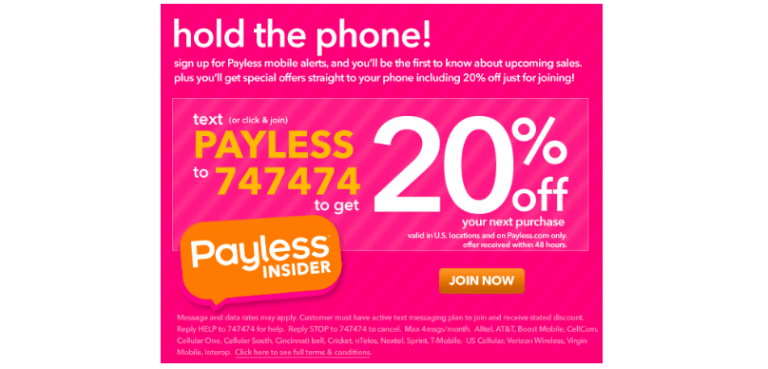
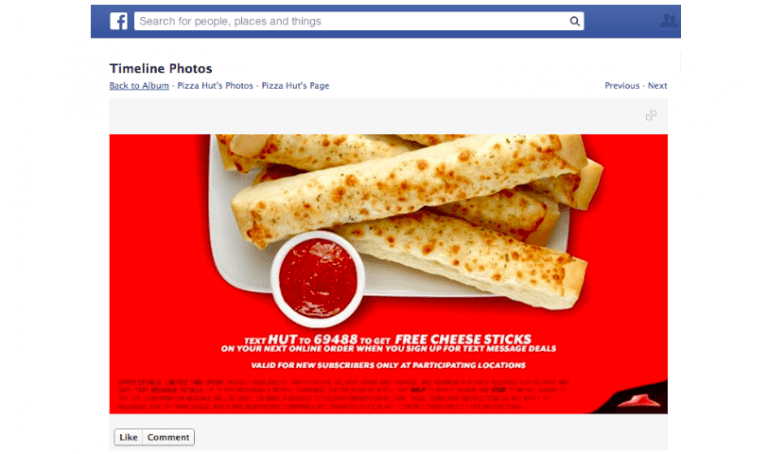
You can encourage signups on any of your current marketing channels: email, website, in-store, social media, direct mail. For example, Payless prints flyers and posts signs near the store checkout, and Pizza Hut spreads the word on Facebook.

text1

text 2

2. Know the Rules

The Cellular Telecommunications Industry Association (CTIA) requires SMS marketers to include “msg & data rates apply” in auto-reply messages. Most text marketing services will add this disclaimer automatically, but it’s on you to ensure it’s included.

3. Less is More

How many SMS is too many?

Upland Software’s in-depth analysis of ideal SMS frequency recommends starting with 4-5 messages a month and slowly increasing to 10 a month — as long each message provides real value. Of course, you should closely monitor unsubscribes for an uptick in churn to find the sweet spot for your own subscribers.

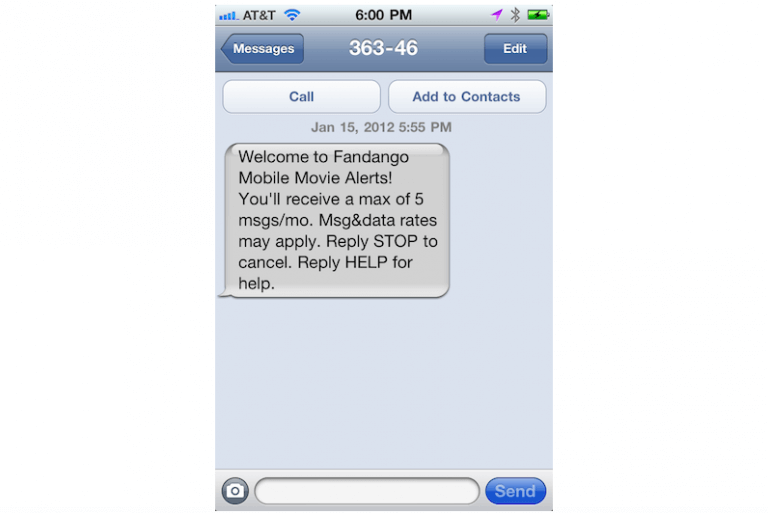
It’s also a good idea to include frequency in your welcome message so users know how often they’ll hear from you:

text3

When it comes to message length, think short and sweet. Most carriers limit text message length to 160 characters, so the faster you get to the meat of your message the better. State value upfront, include a crystal clear call to action and use a URL shortener like goo.gl or bit.ly.

4. Timing Matters

When it comes to timing your text messages, think about your audience’s daily habits. When are they most likely to be on their phones?

According to Mobile Marketer, Mondays have the lowest response rates. Unless your message is specifically relevant to that day, avoid it.

You should also steer clear of common commute times, typically 6:30-8:30 am and 4-7 pm, when people are likely driving and unable to read or respond to texts.

In general, standard business hours of 10 am – 8 pm are most effective for SMS marketers. Just be sure to localize send times for your user’s specific time zone. No one wants a coupon code or appointment reminder at 4 am.

5. Keep it Fun!

SMS is a highly personal and informal channel, making it ideal for entertaining campaigns. Think games, promotions, polls, interactive content, and one-on-one conversations. Use it as an opportunity to deliver fun, memorable customer experiences.

Note: many SMS marketers use shortened to text speak like “ur” and “txt” in campaign copy. Feel free to do the same, as long as your message is easily readable.

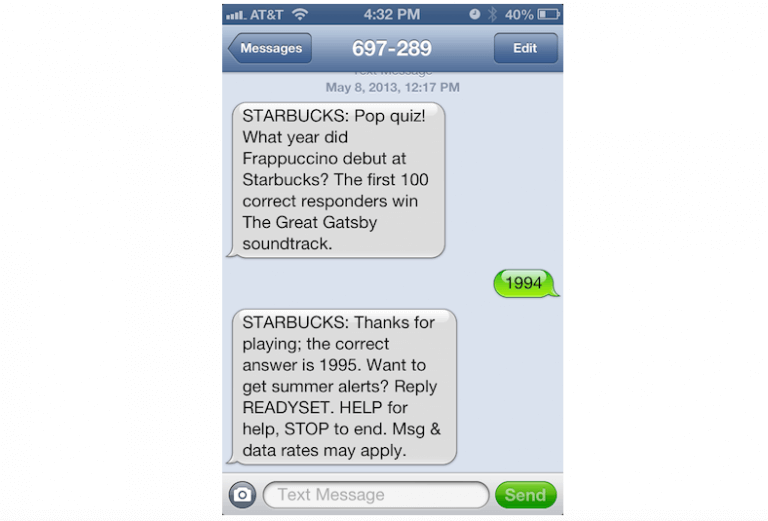
Starbucks has long used SMS to delight customers with trivia games, quirky memes, and personalized rewards. This campaign from 2013 takes advantage of the immediacy of SMS by rewarding the first 100 correct responders. And it cleverly reinforces the essential role music plays in their customer experience.

text4

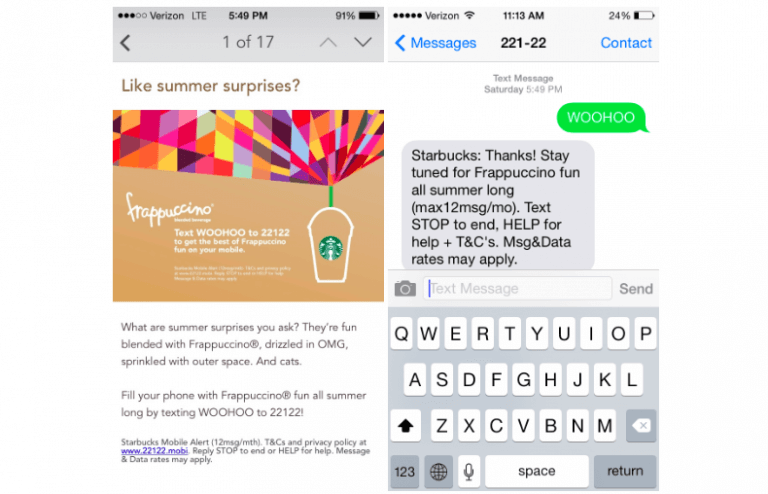
This recent campaign pairs the informal nature of SMS with summertime fun, featuring intergalactic cat gifs, silly “Pew Pew!”s, and OMGs. And it delivers real value with 50% off coupons and extended happy hours for subscribers.

text5


6. Segment

You wouldn’t talk to a brand new visitor the same way you would a loyal customer. The same goes for SMS. Segment your audience to ensure that each user gets relevant, valuable content.

New visitors could get free shipping or promo code, while repeat customers get early access to new products or an invite to your rewards program.

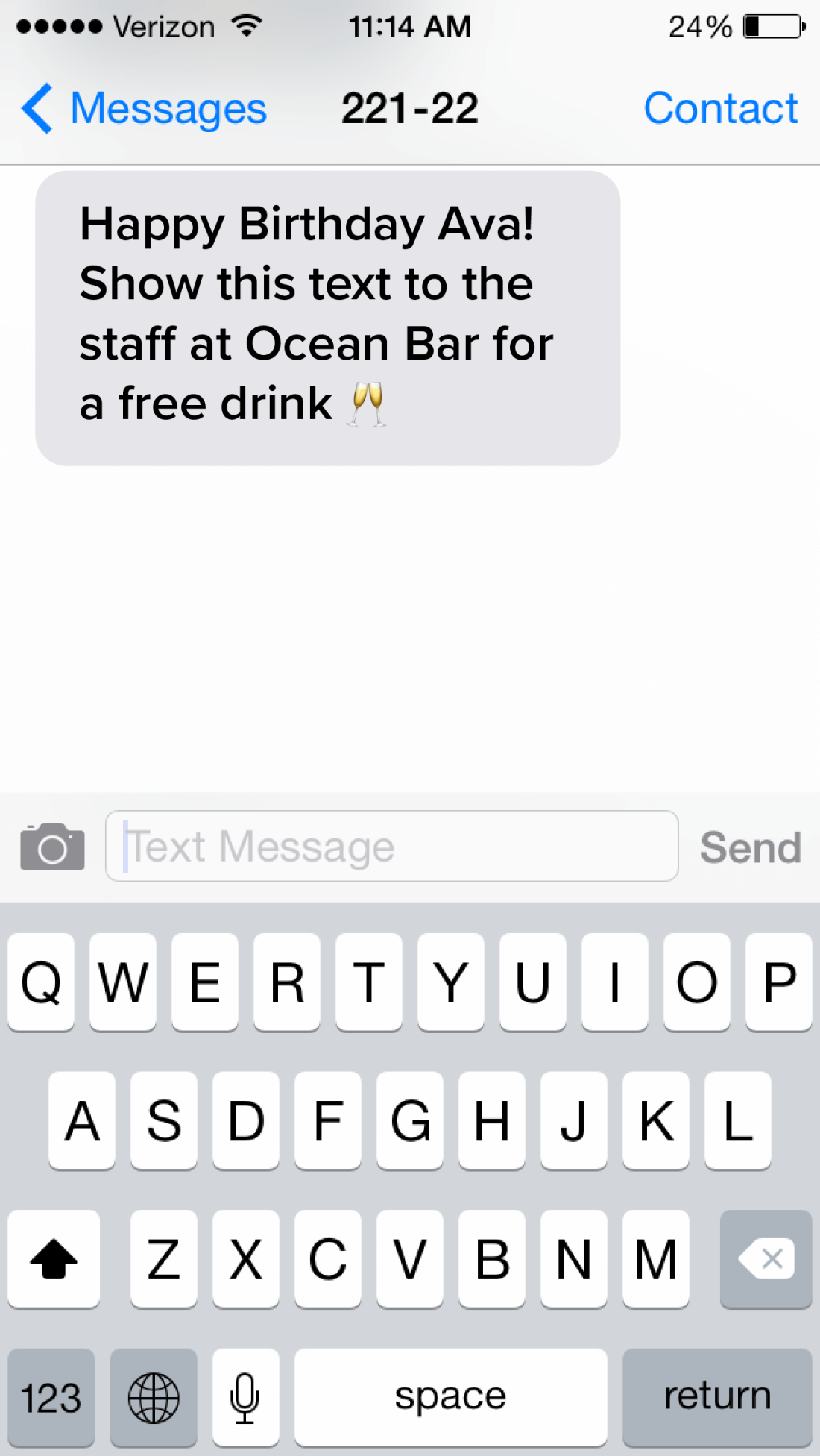
Use profile data to send birthday promotions, new customer discounts, or location-based campaigns to give each user a personalized experience and up conversions.

text7

7. Instill Urgency

One of the central benefits of SMS is immediacy. So use that to your advantage.

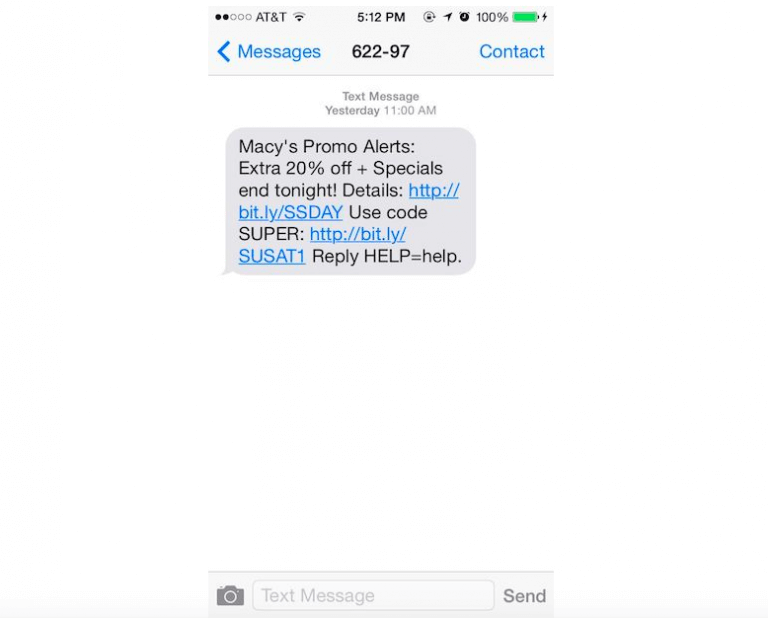
Pair SMS with location-based campaigns to send tempting promotions to users when they arrive or pass by your store. Include phrases like “valid till,” “expires soon,” or “today only” in your message copy to create a sense of urgency and prompt recipients to act.

text8

8. Make It Exclusive

One way to keep subscribers from opting out of your SMS campaigns? Send exclusive offers or VIP content they won’t get on any other channel.

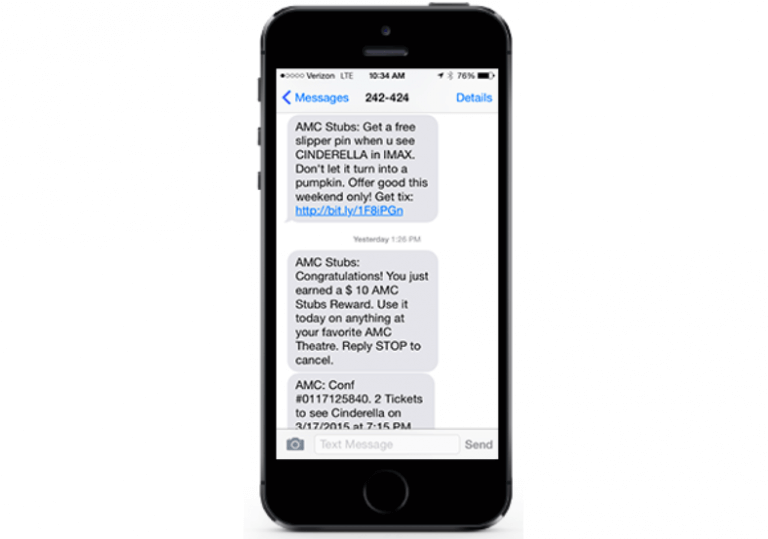
AMC Theaters uses SMS to keep its Stubs club members up to date on their rewards points and membership benefits. Subscribers get access to free movie screenings, special event invites concession discounts and movie swag giveaways.

text9

9. Track Open & Click Rates

As with any other medium, you should track how users are engaging with your text campaigns. How many open your message? How many clicks the link or send a response? How many opt-out?

According to the current SMS marketing industry benchmarks, 70% of customers open SMS messages within 60 minutes. 19% of recipients click on a link.

Like any other channel, you should A/B test messaging, audiences, and timing to keep improving your SMS marketing strategy.

10. Use SMS as Part of an Omnichannel Strategy

Today’s mobile users demand a consistent customer experience regardless of channel or device. An omnichannel strategy is essential to building a strong, lasting relationship with your brand.

Your SMS campaigns shouldn’t be one-offs. They should complement and connect with your push, email, and social campaigns to reinforce customer relationships and provide a seamless experience.text10

5 Ecommerce Marketing Strategies for 2020

As 2020 approaches, the stakes have never been higher for online retailers trying to compete with sellers flooding marketplaces from retailers like Amazon and Walmart—and, in some cases, the direct-to-consumer retailers themselves.

But, thankfully, it is not a hopeless task: We compiled 5 of the best expert-approved eCommerce marketing strategies that you need to try in 2020. By implementing these strategies, eCommerce brands can find the holy grail, which remains the right consumer on the right device at the right moment.


1. Tap into UGC and influencer marketing

Like email signups, Prafull Sharma, CEO of content marketing agency LeadsPanda, recommends brands encourage their fans to produce their own content in exchange for an incentive. This will increase engagement and conversions, as well as build trust within the brand’s digital community. Camera brand GoPro is a good example. Its YouTube channel has nearly 8 million subscribers and a library of high-quality videos from customers.

2. Try filters and QR codes

Sneh Ratna Choudhary, a content marketer at proximity marketing company Beaconstac, said filters on social platforms like Snapchat and Instagram can yield unique shopping experiences for eCommerce brands. That includes denim brand Levi’s, which allowed Snapchat users to scan QR codes in-store to virtually try on a jacket they could then by online, and Kylie Jenner’s makeup brand Kylie Cosmetics, which used Instagram filters to let users see what her new lipsticks looked like.

On a related note, QR codes in print ads allow consumers to easily visit advertisers’ websites.

3. Make shopping social

Aalap Shah, the founder of Amazon/eCommerce-focused agency 1o8, said to consider social commerce platform CommentSold.

“I’m finding for my apparel and beauty clients in particular that this tool creates an effective new sales channel to drive directly into Shopify or owned e-comm sites and stores,” he said. “Social selling in itself is not new, but the tools to create momentum and ease [through automated invoicing, sales analytics, customer data, and inventory and order management] are getting better and better.”

4. Send personalized emails

It’s an oldie, but a goodie: Email marketing. Especially personalized ones.

Brands that are looking to incentivize signups should consider lures like coupons and free trials.

Bernard Wong, the digital marketer for eCommerce site Vape Club, said this strategy has helped the online e-liquid store amass a list of over 45,000 emails so far in the U.K. In addition, he said customers of eCommerce platform Shopify can easily implement the tactic by installing apps from the Shopify App Store like Woohoo.

5. Write newsletters and blog posts

And, of course, you’ll want content. Lots of content.

Calloway Cook, president of dietary supplement company Illuminate Labs, suggests guest blogging as an effective—and cost-effective—a strategy for 2020.

He recommends using a tool like a browser extension MozBar to find the domain authority of sites and to only reach out to those with a domain authority greater than 40.

“It’s a proven way to get high-quality backlinks pointed to your homepage and increase your site’s domain authority [and thereby increase your site’s organic rankings],” Cook said.